



There is a moment in Ratatouille when the critic Anton Ego reflects on Chef Gusteau’s motto, “Anyone Can Cook!” Ego explains that the phrase is misunderstood: it does not mean that everyone can become a great chef, but rather that greatness can come from anywhere.
In this post, we do mean it. The overwhelming evidence indicates that the vast majority of people can learn almost anything, provided they have time, motivation, and the right support. Contrary to common belief, innate ability matters much less than these factors when it comes to learning.
Reviewing the Evidence
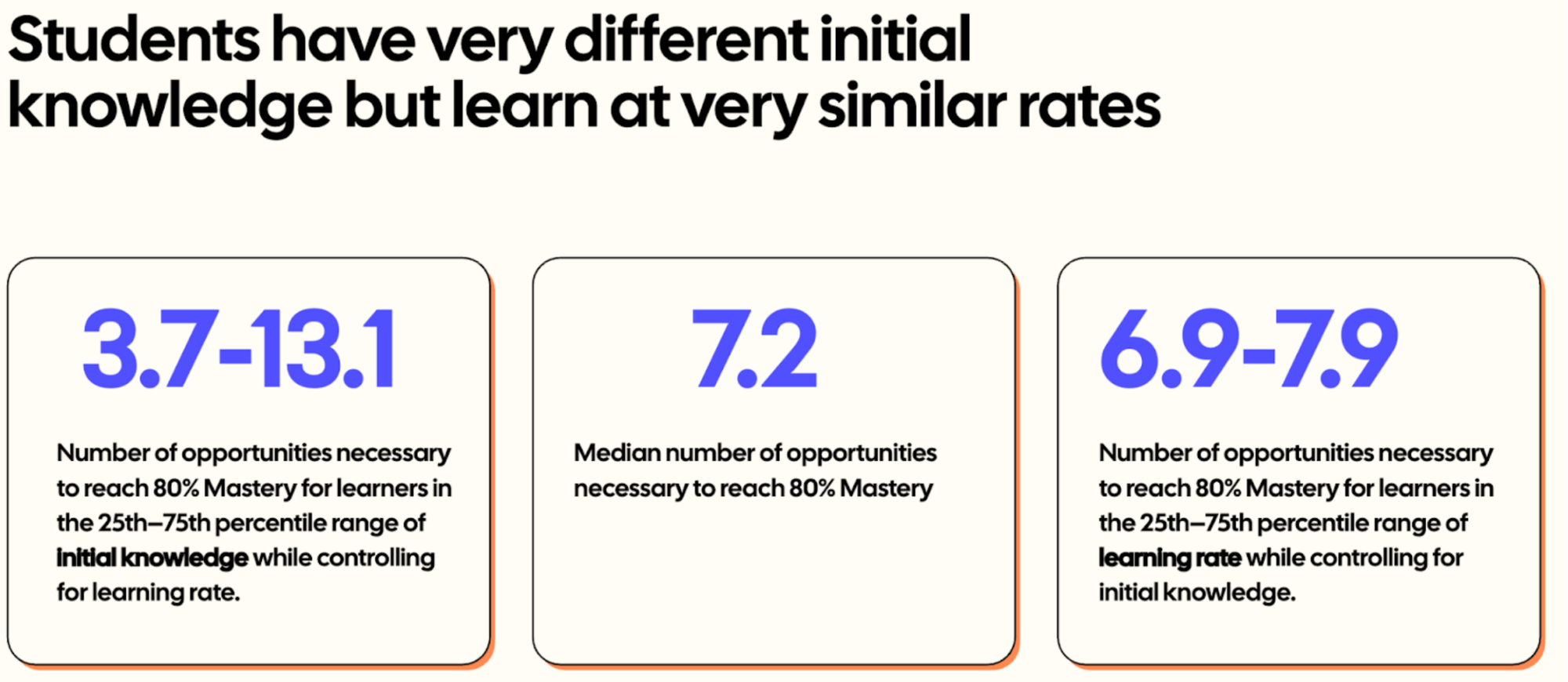
In their paper An astonishing regularity in student learning rate, Koedinger et al. analyzed 1.3 million student interactions across 27 independent datasets. They found that although students begin with widely varying levels of prior knowledge, their rate of improvement per practice opportunity is remarkably consistent. Under favorable learning conditions and strong intrinsic motivation, learning gaps appear to be driven far more by differences in exposure and prior preparation than by differences in inherent learning ability. A second, fully independent replication, supported the same conclusion.
There are many ways to present these results, but my favorite way is to look at the number of learning opportunities necessary to reach 80% mastery (defined here as answering questions correctly 80 percent of the time). There are large differences in initial knowledge across learners, but when controlling for that knowledge, the number of opportunities required to reach this level is surprisingly uniform:
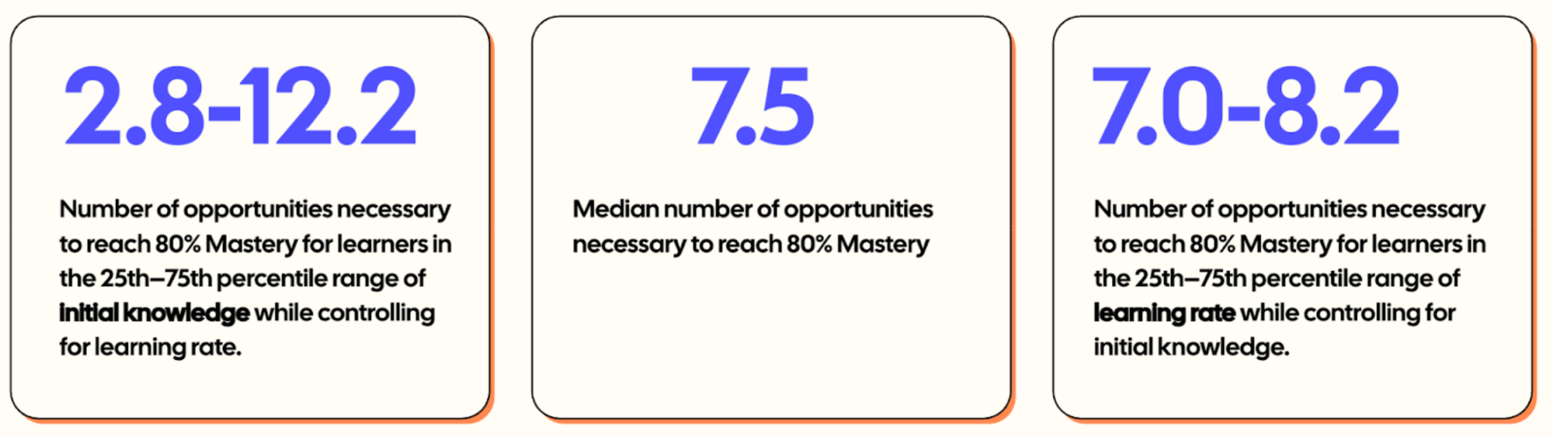
Our own replication came next. It is important to emphasize that Sizzle was not built to validate this claim. It was designed for entirely different purposes. Yet when we analyzed the large amount of data at our disposal, 1.8 million student interactions across an unbounded set of topics, we found strikingly similar results:
None of this is foolproof. There are many reasons these results could still be misleading—measurement issues, sampling biases, missing confounders. We plan to continue testing and challenging the finding. Still, three independent efforts converging on the same pattern makes it, in my view, more likely than not that the effect is real.
Why This Matters
Knowledge and the capacity to learn function as gatekeeping mechanisms for opportunity. Students who show early proficiency are funneled into stronger schools, more advanced coursework, better universities, and ultimately better jobs. But this raises a critical question: what exactly are we selecting for?
Our findings suggest that the system is not selecting for innate learning ability but for prior access to resources and high-quality instruction. These early advantages compound over time: those who start with more are repeatedly selected to receive even more, while those who start with less continue to be offered less. The result is a self-reinforcing cycle.
Motivation may still differentiate learners. Our results assume students engage with the practice opportunities available to them. Ability alone is not enough; willingness matters. But in a world of “haves” and “have-nots,” sustaining motivation among those who begin at a disadvantage is extraordinarily difficult—especially when they are repeatedly told, implicitly or explicitly, that they lack the ability to succeed.
There is a discouraging side to this: our selection system has been privileging early advantage rather than true potential, misallocating opportunities. But there is also a hopeful side: if anyone can learn, then bridging educational gaps is not only possible, it is achievable at a societal level.
What Now?
Ensure educators understand these findings. Teacher expectations shape classroom dynamics. Many of us have encountered a math teacher who assumed large portions of the class were incapable of learning math. That assumption is not just discouraging; it is empirically wrong.
Rethink selection and assessment. If learning capacity is broadly distributed, early performance is a poor proxy for potential. Systems should measure motivation, progress, and growth—not one-time snapshots. Mastery learning, which allows unlimited attempts at assessments, is a proven way to make this shift.
Focus on adaptivity and motivation. The real differentiators are persistence, support, and fit. Adaptive systems, scaffolding and gamification can provide effective learning paths for students who would otherwise be filtered out.
Embrace AI. Mastery learning, scaffolding, and adaptivity are too resource-intensive to deliver at scale through human instruction alone. Recent advances in AI make it possible to offer these methods widely and cost-effectively.
High quality education for everyone
If we take the evidence seriously, the implications are profound. Ability is not destiny. Potential is not predetermined. “Anyone can learn” is an evidence-based truth—and that makes universal access to high-quality education one of the strongest returns on investment available to society.