

Campus is the new alternative to online community college that provides a 100% live and online Associate of Arts in Business Administration degree program. Our comprehensive, career-focused business program equips students from across the U.S. with a solid foundation in core business principles to set them up for success no matter what their next step is. Read on to explore the world of business and how starting with a business degree might be your next best move.
If you want to run your own company one day, you may wonder whether a small business degree is the right place to start. A small business management degree can help students build practical knowledge in areas like finance, marketing, operations, communication, and entrepreneurship, all of which matter when launching or managing a business.
For many students, the appeal of a small business management degree is that it connects business fundamentals to the realities of ownership. Instead of learning only general theory, students may explore how to manage growth, make decisions, work with customers, understand finances, and handle the day-to-day demands of a business.
In this guide, we’ll look at what a small business management degree covers, what small business management courses may include, and whether this path makes sense for future small business owners.
Want to learn more about Campus?
Our admissions advisors can answer your questions.
What is Small Business Management?
Small business management focuses on the day-to-day and long-term work involved in running a smaller business successfully. That can include managing employees, overseeing finances, communicating with customers or vendors, handling operations, and making decisions that support growth and stability.
For future owners, these responsibilities matter because small businesses often require leaders to wear multiple hats. That is one reason students interested in ownership or entrepreneurship may look for a small business management program or related business degree path.
What Do You Learn in a Small Business Management Degree Program?
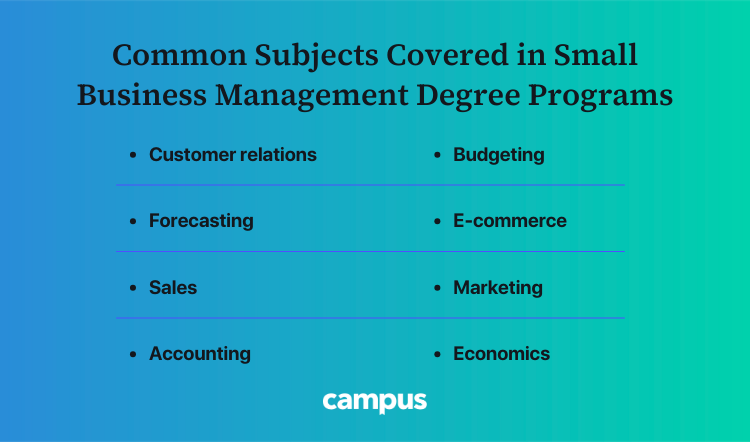
A small business management degree is designed to help students build practical business knowledge they can apply to ownership, entrepreneurship, or small business operations. While every school structures programs differently, small business management courses often touch on areas such as:
- budgeting and finance
- marketing and promotion
- customer relations
- operations and workflow management
- sales and business development
- entrepreneurship
- e-commerce
- communication
- planning and forecasting
These courses can help students build skills in leadership, organization, decision-making, marketing, operations, and financial awareness. For students thinking about ownership, that combination can be especially valuable because small business owners often need to manage several parts of the business at once.
Depending on the program and degree level, timelines can vary. Associate-level paths may take around two years, while bachelor’s-level programs may take around four years.
Want to learn more about Campus?
Our admissions advisors can answer your questions.
Types of Small Business Management Degree Paths
Students interested in small business management usually have a few possible education paths.
Associate-level path An associate degree can be a practical option for students who want to build foundational business skills in a shorter time frame. In many cases, this kind of path can support entry-level work, transfer opportunities, or early preparation for future business ownership.
Bachelor’s-level path A bachelor’s degree usually goes deeper into business strategy, management, finance, marketing, and entrepreneurship. This may be a stronger fit for students who want a longer academic path or broader preparation before launching or leading a business.
Graduate-level path MBA or advanced specialized programs may be relevant for students who want deeper leadership training or later-career advancement, but they are not usually the first step for someone simply asking what degree they need to own a business.
For many students, a related business administration degree with strong entrepreneurship or small-business-relevant coursework can also serve this purpose well.
Do You Need a Small Business Degree to Own a Business?
You do not need a formal degree to own a business. Many entrepreneurs build businesses through experience, mentorship, self-education, or hands-on learning.
That said, a small business degree can still be useful. It can help future owners build confidence in areas like budgeting, operations, marketing, communication, and decision-making. For students who want more structure before launching a business, that education can be valuable.

What Can You Do With a Small Business Management Degree?
A small business management degree can support more than one path. Some students may want to start or grow their own business, while others may use the degree in roles tied to operations, project coordination, customer relations, finance support, marketing, or general business management.
That flexibility is one reason this kind of degree appeals to future owners. The skills can apply both to entrepreneurship and to broader business roles if you want to build experience before launching something of your own.
Ready to Build Small Business Skills?
A small business management degree can be a strong option for students who want to understand ownership, entrepreneurship, and the realities of running a business. It can help students build practical skills they may use in a business of their own or in related business roles.
At Campus, students can build a broad business foundation through the online associate degree in business program. For students interested in small business ownership, that kind of foundation can support learning in areas like management, marketing, accounting, finance, and communication. Request more info to learn more.
Want to learn more about Campus?
Our admissions advisors can answer your questions.
FAQ
What is a small business degree?
A small business degree usually refers to a program focused on entrepreneurship, ownership, and the skills needed to run a smaller business. That may include topics like finance, marketing, operations, communication, and management.
Is a small business management degree worth it?
For some students, yes. A small business management degree can be worth it if you want structured learning in the areas that matter most to ownership, such as budgeting, marketing, operations, planning, and decision-making.
What degree do you need to own a business?
You do not need a specific degree to own a business. However, many future owners choose business-related education because it can help them build practical skills and confidence before launching or growing a company.
What courses are in a small business management program?
Small business management courses often include budgeting, finance, marketing, customer relations, entrepreneurship, operations, communication, and forecasting. Exact coursework depends on the school and degree level.
Can you get a small business degree online?
Yes, some schools offer online options that can support students interested in entrepreneurship or small business ownership. Online learning can be especially appealing for students who need flexibility while building business knowledge.
Is a business administration degree good for small business owners?
Yes. A business administration degree can be a strong option for future small business owners because it covers core areas like management, finance, marketing, operations, and communication that are highly relevant to ownership.
What can you do with a small business management degree?
You can use a small business management degree to prepare for ownership, entrepreneurship, or a range of business-related roles in operations, customer relations, project coordination, finance support, or general business management.
What is the best degree for entrepreneurs?
There is no single best degree for every entrepreneur. A small business management degree can be a strong fit for ownership-focused students, while a broader business administration degree may be better for students who want flexible business fundamentals they can apply in different directions.