

I’m Cesar, a director of Student Success at Campus. Every day, I get to work with an incredible team of Success Coaches who support our students from the moment they enroll through graduation. A big part of my job is constantly asking, “How can we make the student experience even better?” Sometimes that means rethinking how we communicate. Sometimes it means improving an existing process. And sometimes, it means building something entirely new.
Lately, my curiosity has led me to spend a lot of time experimenting with AI. I wasn't trying to build something flashy or prove a point about new technology - I simply wanted to see whether these tools could help us create a better experience for students. This project became one of the most rewarding things I’ve worked on recently. Along the way I learned a lot about what's possible, where AI sometimes falls short, and why human judgment still matters every step of the way.
Reimagining a Familiar Student Experience
Our students already had access to their grades. But every quarter, I found myself thinking that a list of grades doesn't really tell the whole story. We didn’t have a way to pull everything together - credits earned, GPA, graduation progress, a message that actually felt personal – into one experience worth opening. That gap is what this project was about.
Around the same time, I’d been spending more time with AI tools like ChatGPT and Cursor. I’d used them for research and smaller projects, but I was curious whether they could help me build something more substantial. This became the perfect opportunity to find out.
From Concept to Working Prototype
One of the biggest misconceptions about AI projects is that they start with code. I’ve found that these kinds of projects usually work by first figuring out the experience you’re trying to create.
I began by looking at how other organizations communicate milestones and what made progress feel visible and meaningful. Using Cursor and AI-assisted prompting, I explored different report layouts, progress indicators, visual treatments, and messaging approaches.
Design isn’t my primary skill, but AI helped me move from rough ideas to working wireframes much faster than I could have on my own.
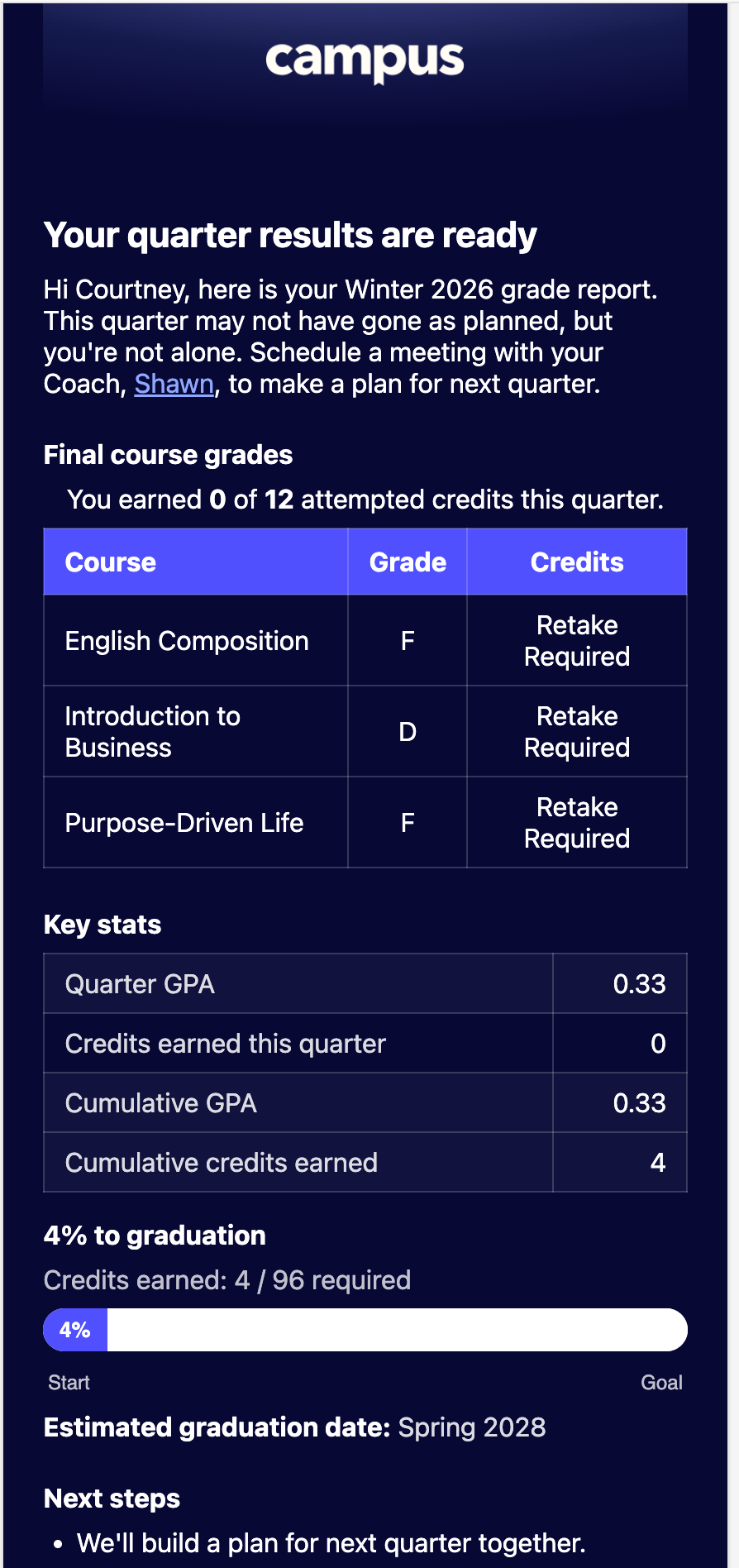
Once the concept was clear, I built the workflow. The system generates a personalized academic progress summary for each student at the end of each quarter. It pulls together academic data, selects the appropriate content, assembles the report, and delivers a branded HTML email.
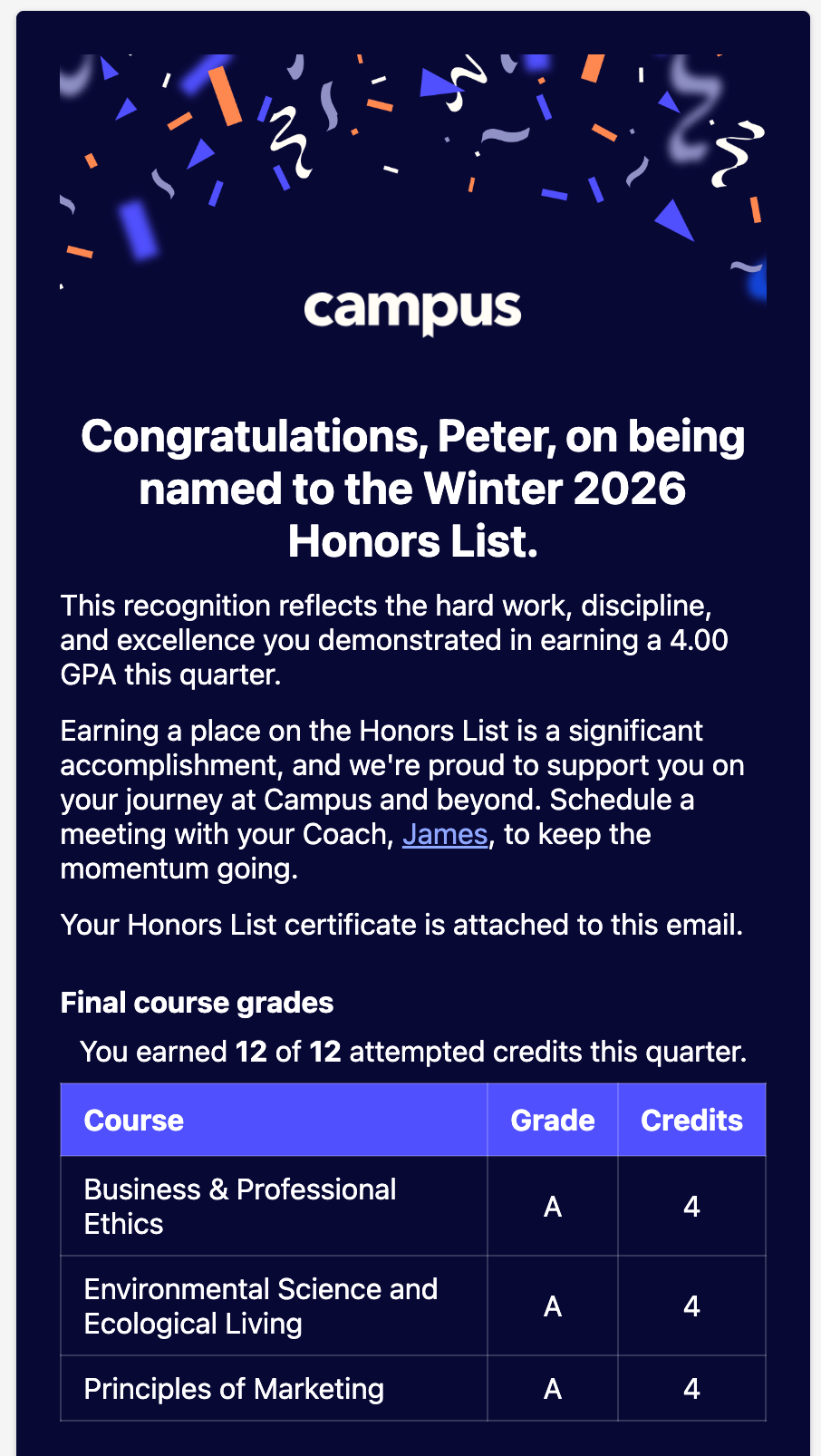
Each report is dynamically customized based on the student's academic record while maintaining a consistent Campus experience. Depending on the student's results, the system can tailor elements including:
- The opening message and overall tone
- Visual treatments, such as celebratory graphics for major milestones
- Course grade summaries
- Quarter and cumulative GPA
- Credits earned and cumulative credits completed
- Degree progress visualization
- Estimated graduation timeline
- Encouragement and support resources when additional guidance may be helpful
While the content changes from student to student, the goal stays the same: give every student a clear, personalized snapshot of where they are in their academic journey and what comes next.
One thing I built in from the start was a review step before anything goes out. I shared prototypes with teammates, gathered feedback, and refined the experience based on their input. Outputs are validated internally before being sent, making it easier to catch issues without slowing the process down.
Not everything worked on the first try.
HTML email development was harder than I expected. Getting progress bars and responsive layouts to render consistently across email clients is genuinely painful, and AI didn’t fix that. I still had to research rendering limitations, test different implementations, and work through a lot of trial and error.
The messaging took more iteration, too. AI generated strong first drafts quickly, but making sure every version felt encouraging, authentic, and appropriate for the student's situation still required thoughtful human review.
What Surprised Me Most
The most surprising part wasn’t how capable the tools were. It was how they changed the way I worked.
Before this project, I would have assumed something like this needed a designer, a developer, and operations support to get off the ground. Instead, I found myself moving between all of those roles - sketching ideas, building prototypes, writing code, testing workflows, and refining the experience - with AI acting like a collaborator throughout the process. It didn't replace expertise, but it gave me the confidence to experiment and the ability to move much faster than I could have on my own.
That said, AI worked best when I came in with clear goals and actual domain knowledge. The tools could generate ideas, code, and content. They couldn’t decide what the student experience should feel like, or whether a solution actually met Campus standards. That part was still on me.
Looking back, the project took about two months from concept to completion, though the actual build was much shorter. Most of the time went into refining the experience, validating outputs, and looping in stakeholders. Speed matters, but the careful review is what made it something worth shipping.
The Results and What’s Next
Today, the workflow gives Campus a repeatable way to create personalized, quarterly progress reports for every student. Instead of rebuilding from scratch every term, my team can focus on reviewing and improving the experience. It’s more consistent, more scalable, and easier to maintain.
The biggest outcome, though, isn't automation. It’s that our students get a clearer, more personalized snapshot of their academic journey. Their progress, achievements, and next steps are presented in one place, with messaging that's tailored to where they are and what support they may need. My hope is that every student opens one of these reports feeling like we took the time to understand where they are - not just academically, but in their overall journey at Campus.
Working on this project also changed the way I think about AI. Before, I saw it as a tool for brainstorming or speeding up small tasks. Now I see it as a practical collaborator that can help turn an idea into something real. It doesn't replace the need for thoughtful design, good judgment, or human review, but it does make it possible to build and iterate in ways that would have felt out of reach before.
Advice for Anyone Just Getting Started
Start with a real problem, not a tool.
It’s easy to spend hours experimenting with prompts and not actually build anything. The real learning happens when you’re solving something specific. Find a process that’s repetitive, slow, or could create a better experience for the people you serve, and see what AI can help you accomplish.
You don’t need to be an engineer. Tools like Cursor and ChatGPT have made prototyping and automation genuinely accessible to people without a technical background.
That said, human judgment still matters. You need clear objectives, a thoughtful review process, and the patience to iterate when things don’t work the first time. AI can help you build, but it's up to you to decide what should be built and whether it truly meets the needs of the people you're building it for.
Looking back, this project started with a simple question: Could we make one part of the student experience a little better? At the end of the day, if I can use AI tools to help our students feel more informed, more supported, and more confident in their journey, then I'll consider that time well spent.