
Donald Rarick
Captain
U.S. Air Force


In 2 years you can have an A.S. in IT with a concentration in Cybersecurity.
Meet live with professors and classmates.
Full Pell Grant recipients can attend with little to no out-of-pocket tuition costs.1
[1] Financial aid is available to those who qualify. Eligibility is determined through the FAFSA and may vary by student.
Prepare for key industry certifications with exam vouchers provided for students who meet eligibility requirements.
Cybersecurity is one of the fastest-growing careers in the country and one of the most essential. Organizations ranging from hospitals, banks, schools and government agencies often rely on professionals who can defend their systems and data against digital threats. A degree in IT along with a concentration in cybersecurity builds foundational technical skills aligned with the current cybersecurity and IT landscape.
The numbers behind the demand are hard to ignore. The U.S. Bureau of Labor Statistics projects information security analyst jobs to grow 29% from 2024 to 2034 which is many times the national average. The median annual wage is $124,910 (BLS, May 2024) and entry-level roles like Tier 1 SOC analyst or Cybersecurity Technician are some of the most accessible on-ramps into the field. Globally, the cybersecurity workforce gap is estimated at more than four million open roles and industry reports continue to show significant employer demand for cybersecurity professionals.
¹ When considering job growth and salary figures, keep in mind that real-world outcomes can differ based on a range of factors—such as years of experience, industry, location, individual skill and broader economic conditions. Cited projections are based on Bureau of Labor Statistics data, not on Campus graduate outcomes, and do not guarantee actual salary or job growth.
The Cybersecurity Concentration within the Associate of Science in Information Technology is built for students who want more than certificates — they want a real degree and real career skills. Students will build a strong IT foundation in networking, Linux, cloud and enterprise systems.
In the concentration courses, you'll go deeper into how security work actually happens: monitoring systems for threats, responding to incidents, working with AI-powered security tools and penetration testing systems through ethical hacking. You'll also cover IT ethics, data privacy and the legal frameworks that govern the security sector. Coursework is mapped directly to leading industry certifications, helping you build foundational cybersecurity and IT skills while preparing for your next step, whether that's transferring into a bachelor's program or starting an entry-level cybersecurity role. By graduation, you'll have a strong technical foundation, a clear certification pathway and hands-on experience across the core areas of modern cybersecurity.
This program helps graduates prepare for entry-level IT and security-adjacent roles and positions them for advancement as they gain experience and certifications. Some entry-level IT and security-support roles may not require a four-year degree and may consider equivalent experience, certifications or demonstrated skills. Job requirements vary by employer. Skills-based hiring is gaining momentum in cybersecurity, with employers increasingly open to candidates from a broader range of educational backgrounds.
These roles commonly require additional education i.e. bachelors degree, certification, prior IT or cybersecurity experience, and/or employer specific qualifications. Employment is not guaranteed.
*Career outcomes and salaries vary by experience, employer, and location. Employment is not guaranteed. Some salary data is sourced from the U.S. Bureau of Labor Statistics Occupational Outlook Handbook, May 2024 and some salary estimates are sourced from third-party job posting data. BLS median wage estimates reflect workers across all experience levels and do not represent entry-level wages. Advancement roles typically require additional education (i.e. bachelor's degree), certifications and relevant work experience.
Grants and other forms of tuition assistance are available to those who qualify. To find out what you're eligible for, contact an admissions counselor.
Students enrolled in 7–12 credits per quarter are charged a flat tuition rate of $2,440. Students taking 6 credits or fewer are charged $200 per credit. Students enrolling in more than 12 credits are charged the flat rate of $2,440, plus $200 per credit for each additional credit above 12.
| Academic Year* | Calendar Year** | |
|---|---|---|
| Quarter 1 | $2,440 | $2,440 |
| Quarter 2 | $2,440 | $2,440 |
| Quarter 3 | $2,440 | $2,440 |
| Quarter 4 | - | $2,440 |
| Annual Cost | $7,320 | $9,760 |
*Students completing three quarters per year will complete the program in 2.5 years.
**Most Campus students attend classes during all four quarters of the year.
A one-time $20 enrollment deposit may be required, to reserve a student's seat in class. Refund eligibility and applicable terms vary by program and enrollment status. Additional details regarding enrollment deposit terms, deferrals, and refund conditions can be found in the Campus Catalog.
Financial aid is available to those who qualify. Eligibility is determined through the Free Application for Federal Student Aid (FAFSA) and other applicable requirements. Awards may vary based on financial need, program, enrollment status, and availability of funds. Campus does not guarantee financial aid or student loan approval.
You'll learn from professors who bring real cybersecurity experience into the classroom — practitioners who understand how security work actually happens, not just how it's described in a textbook. Campus faculty also teach at some of the top-ranked institutions in the country.
Learn more about our faculty.
Captain
U.S. Air Force

Also teaches at:
UC Davis

Also teaches at:
Northwestern
To earn an Associate of Science in Information Technology with a Concentration in Cybersecurity, students must complete 96 quarter credit hours. The concentration courses are embedded in the final four quarters of the program.
Each quarter is 11 weeks long, including 10 weeks of instruction and a final exam week.
Note: The actual sequence of courses may vary per student.
The following five courses make up the Cybersecurity Concentration, completed in the final four quarters of the program. For the full list of degree program courses, visit the A.S. in Information Technology page.
Core security concepts, threats, vulnerabilities, and defensive strategies — aligned to the CompTIA Security+ (SY0-701) exam.
Day-to-day work of security professionals: SIEM platforms, log analysis, threat intelligence, alert triage, and incident response procedures — aligned to the CompTIA CySA+ (CS0-003) exam.
How to think like an adversary: reconnaissance, scanning, exploitation, and professional penetration testing methodology — aligned to the EC-Council CEH exam.
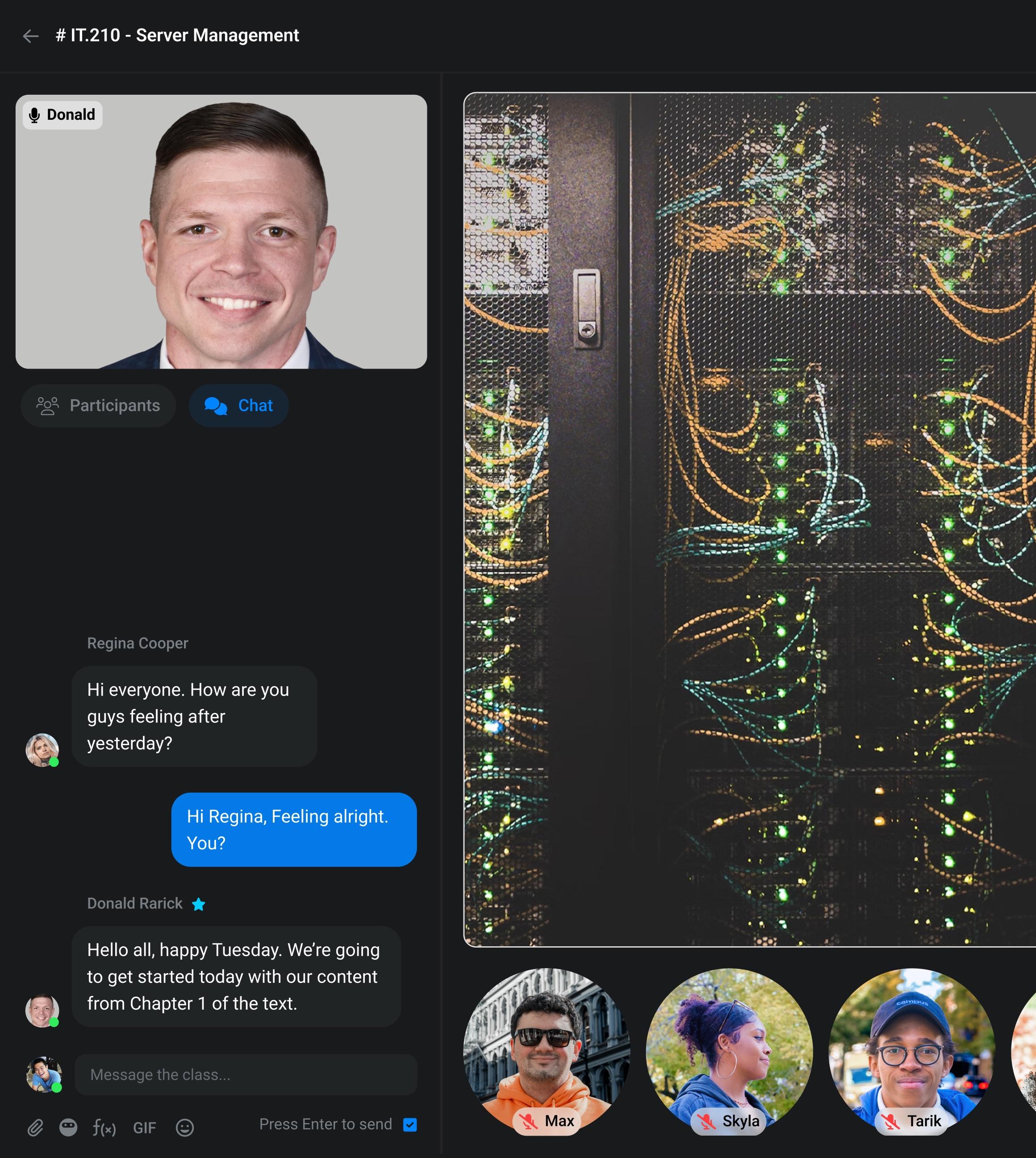
All classes in the Campus online degree programs are live so that you can directly interact with professors and peers. We keep things engaging by holding lively discussions and debates, breakout sessions, forums, and more.
For long-term growth in cybersecurity, a degree can make a major difference. Some entry-level roles, like junior SOC analyst or help desk security positions, can be landed with certifications and relevant experience. Many mid-level and senior cybersecurity jobs, however, list a degree as a preferred or required qualification, and employers increasingly view a degree as a signal that you've completed a structured, rigorous program. A degree may also unlock paths a certification alone can't, including transfer into a bachelor's program. Campus's Associate of Science in IT with a Cybersecurity Concentration prepares you for both: you graduate with an accredited degree and preparation for the Security+, CySA+, and Certified Ethical Hacker (CEH) exams.
Cybersecurity can be challenging, but many beginners successfully learn it through a structured program. The field covers a wide range of skills, but you don't have to master all of them at once. Most beginners start with IT fundamentals like networking and Linux, then build into security concepts step by step. Campus's Associate of Science in IT with a Cybersecurity Concentration is designed for beginners: no prior experience required, two years of structured coursework, and preparation for prominent industry certifications.
The most widely recognized cybersecurity certifications fall into three tiers. For entry-level roles, employers look for CompTIA Security+ as the baseline, often alongside CompTIA Network+ and A+ to confirm core IT skills. For early-career specialists, CompTIA CySA+ (security analyst) and EC-Council Certified Ethical Hacker (CEH) are common requirements for SOC analyst, threat hunter, and penetration testing roles. For mid- and senior-level positions, CISSP, CISM and AWS Certified Security – Specialty carry more weight. Campus's Associate of Science in IT with a Cybersecurity Concentration prepares you for the certifications that matter most at the start of your career: Security+, Network+, A+, CySA+, CEH, AWS Cloud Practitioner and AWS Solutions Architect.
Yes, for students meeting eligibility requirements. Students who earn a B or higher in both the final course grade and final exam for a qualifying course are eligible for a Campus-funded exam voucher. You can hold one unused voucher at a time. A failure policy applies — speak with an admissions counselor for full details.
We will provide assistance if your plan is to transfer to a four year program. While credit acceptance is always at the discretion of the receiving institution, Campus is an accredited college and our classes are designed with transfer in mind.
Campus is Title IV eligible. Students who qualify for federal grants or other financial aid can apply that funding toward tuition. Contact an admissions counselor to find out what you're eligible for.
Apply here. Our admissions counselors are also available to answer questions and walk you through the process.
Our admissions counselors are here to answer any questions and help you navigate the admissions process.
If you’re savvy, ambitious, and looking to knock out the first two years of college while learning from some of the best professors in the country, we should talk.