
Jeff Eyet
Also teaches at:
UC Berkeley


In 2 years you can have an Associate Degree in Healthcare Administration.
Meet live with professors and classmates twice each week.
Full Pell Grant recipients can attend with little to no out-of-pocket tuition costs.1
[1] Financial aid is available to those who qualify. Eligibility is determined through the FAFSA and may vary by student.
We'll provide assistance as you transfer2 into a university.
[2] Transfer credit is always up to the discretion of the receiving institution.
Healthcare doesn't just happen in exam rooms. It runs on coordination, systems, compliance, and people who know how to keep everything moving. Our online Associate of Science in Healthcare Administration at Campus is designed for students who want to be part of that engine.
This is a modern healthcare administration degree that's built around how healthcare actually works today and offers a practical path forward in one of the fastest-growing sectors of the economy.
You'll build the practical, job-ready skills healthcare organizations rely on every day. This program focuses on how administrative teams support patients, providers, and operations in modern healthcare settings.
You'll learn how to:
By the end of the program, you'll have developed practical skills commonly used in entry-level healthcare administration settings – and a foundation you can continue building on as you gain experience.
Healthcare remains one of the most stable and consistently growing sectors of the economy. As systems expand and modernize, the need for skilled administrative professionals continues to increase.
An associate degree in Healthcare Administration can prepare you for administrative roles in clinics, hospitals and outpatient settings. Depending on experience and location, graduates may pursue positions that focus on patient coordination, documentation, compliance, billing support, and daily operational workflows. Individuals with an associate degree in healthcare administration may pursue roles such as:
Professionals who continue their education may pursue roles such as:
The U.S. Bureau of Labor Statistics projects 23% growth for Medical and Health Services Managers from 2024 to 2034 – much faster than the average for all occupations.
Career outcomes and salaries vary by experience, employer, and location, and employment is not guaranteed. All career and salary information above is sourced from the U.S. Bureau of Labor Statistics (BLS) unless otherwise noted.
Grants and other forms of tuition assistance are available to those who qualify. To find out what you're eligible for, contact an admissions counselor.
Students enrolled in 7–12 credits per quarter are charged a flat tuition rate of $2,440. Students taking 6 credits or fewer are charged $200 per credit. Students enrolling in more than 12 credits are charged the flat rate of $2,440, plus $200 per credit for each additional credit above 12.
| Academic Year* | Calendar Year** | |
|---|---|---|
| Quarter 1 | $2,440 | $2,440 |
| Quarter 2 | $2,440 | $2,440 |
| Quarter 3 | $2,440 | $2,440 |
| Quarter 4 | - | $2,440 |
| Annual Cost | $7,320 | $9,760 |
*Students completing three quarters per year will complete the program in 2.5 years.
**Most Campus students attend classes during all four quarters of the year.
A one-time $20 enrollment deposit may be required, to reserve a student's seat in class. Refund eligibility and applicable terms vary by program and enrollment status. Additional details regarding enrollment deposit terms, deferrals, and refund conditions can be found in the Campus Catalog.
Financial aid is available to those who qualify. Eligibility is determined through the Free Application for Federal Student Aid (FAFSA) and other applicable requirements. Awards may vary based on financial need, program, enrollment status, and availability of funds. Campus does not guarantee financial aid or student loan approval.
You'll benefit from access to professors who also teach at some of the best colleges in the country, including Princeton, Stanford, UT Austin, Howard, and more. Campus' professors are subject experts who bring a variety of online and industry experience to the virtual classroom. Elevate your online learning experience through dynamic live sessions and optional office hours each week.
Learn more about our world-class faculty.
Students in the Online Associate of Science in Healthcare Administration degree program must complete 96 quarter credits to earn their degree. Below is an example sequence of courses based on an eight-quarter completion schedule.
Each quarter is 11 weeks long, including 10 weeks of live instruction and one final assessment week. Students typically enroll in 12 credits per quarter when attending full time. Completion time may vary based on transfer credits and course load.
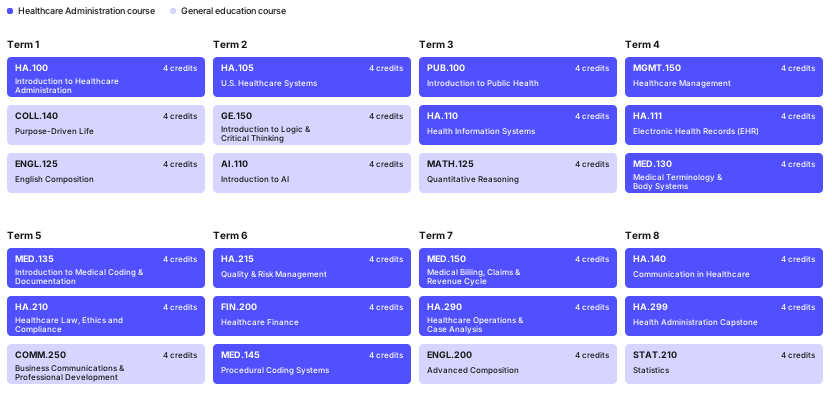
Course titles and sequencing are subject to change. The curriculum includes coursework in healthcare systems, law and compliance, operations management, revenue cycle processes, health information systems, and applied case-based learning, culminating in a capstone project.

All classes in the Campus Scholars programs are live so that you can directly interact with professors and peers. We keep things engaging by holding lively discussions and debates, breakout sessions, forums, and more.
An associate degree in healthcare administration can prepare you for entry-level administrative roles that support healthcare operations. These roles focus on patient coordination, documentation, insurance processes, and daily workflow management.
Graduates may pursue positions such as medical office administrator, patient access representative, medical records or health information clerk, enrollment coordinator, or practice operations coordinator. Responsibilities often include scheduling, maintaining electronic health records, verifying insurance, and supporting compliance.
This degree is designed to support your entry into the field in an administrative capacity and build a foundation for future advancement. Some graduates continue to a bachelor's degree to pursue supervisory roles. Employment outcomes are not guaranteed and vary by location and experience.
The program is designed to be completed in eight quarters (approximately two years) when attending full time at 12 credits per quarter.
Classes are delivered live and online on a structured schedule. This format provides accountability and interaction while allowing you to study remotely.
Completion time may vary based on transfer credits and course load. Speak with an admissions counselor to review your timeline options.
Healthcare administration may be a strong option for individuals who want to work in healthcare without providing direct clinical care. Administrative professionals support patient services, operations, and compliance across healthcare organizations.
The U.S. Bureau of Labor Statistics projects 23% growth for Medical and Health Services Managers from 2024 to 2034, faster than average for all occupations. While many leadership roles require a bachelor's degree and experience, industry growth supports continued demand for administrative professionals.
Career outcomes depend on individual factors, and employment is not guaranteed.
Healthcare administration is a broad field focused on operations, patient coordination, compliance and workflow management within healthcare organizations.
Healthcare management typically focuses more on leadership, strategy and decision making. Managers may oversee departments, manage budgets, lead teams and develop organizational policies.
At the associate degree level, programs often blend both concepts. As you advance to a bachelor's or master's degree, the distinction between administration and management becomes more defined.
This program covers billing and coding fundamentals as part of a broader administrative curriculum designed to prepare students for multi-function healthcare roles.
Students enrolled in 7-12 credits per quarter are charged a flat tuition rate of $2,440. Students taking 6 credits or fewer are charged $200 per credit. Students enrolling in more than 12 credits are charged the flat rate of $2,440, plus $200 per credit for each additional credit above 12. Full program tuition is $19,520, based on paying $2,440 per term.
Financial aid is available to those who qualify. Grants and other funding may also be available to help reduce out-of-pocket costs.
Additional fees and supplies may apply. See the Catalog for full cost details.
Speak with an admissions counselor or financial aid advisor to review your options.
The Associate of Science in Healthcare Administration includes foundational coursework in electronic health records, billing and coding basics, revenue cycle concepts, healthcare law and compliance, and health information systems. These areas overlap with content commonly tested on some entry-level administrative and coding exams.
However, this program is not designed to prepare students for any specific certification exam and does not guarantee eligibility for, or success on, any certification. Certification requirements vary by credential and may include specific coursework, clinical hours, or separate application processes.
If you're interested in a particular certification, we recommend reviewing the eligibility requirements for that credential and speaking with an admissions counselor or academic advisor about your goals.
This associate degree is designed to provide an academic foundation that may support transfer to a bachelor's program, depending on the receiving institution.
Credit acceptance is determined by the transfer institution. Students planning to continue their education should review transfer requirements early.
Speak with an admissions counselor to discuss long-term academic goals.
Healthcare administration offers a career path that combines meaningful work with a range of earning outcomes. Professionals with an Associate of Science in Healthcare Administration typically enter the workforce in technical or administrative roles. According to the U.S. Bureau of Labor Statistics (BLS) , median annual wages for Medical Records Specialist roles are $50,250 as of 2024.
Earning potential may increase with additional education and experience. According to the U.S. Bureau of Labor Statistics (BLS) , Medical and Health Services Manager – roles that typically require a bachelor's degree and experience – have a median annual wage of $117,960 and are projected to grow by 23% from 2024 to 2034, faster than the average for all occupations. By incorporating AI and digital health concepts, this program is designed to help you develop skills aligned with the evolving demands of modern healthcare operations.
Our admissions counselors are here to answer any questions and help you navigate the admissions process.
If you’re savvy, ambitious, and looking to knock out the first two years of college while learning from some of the best professors in the country, we should talk.