
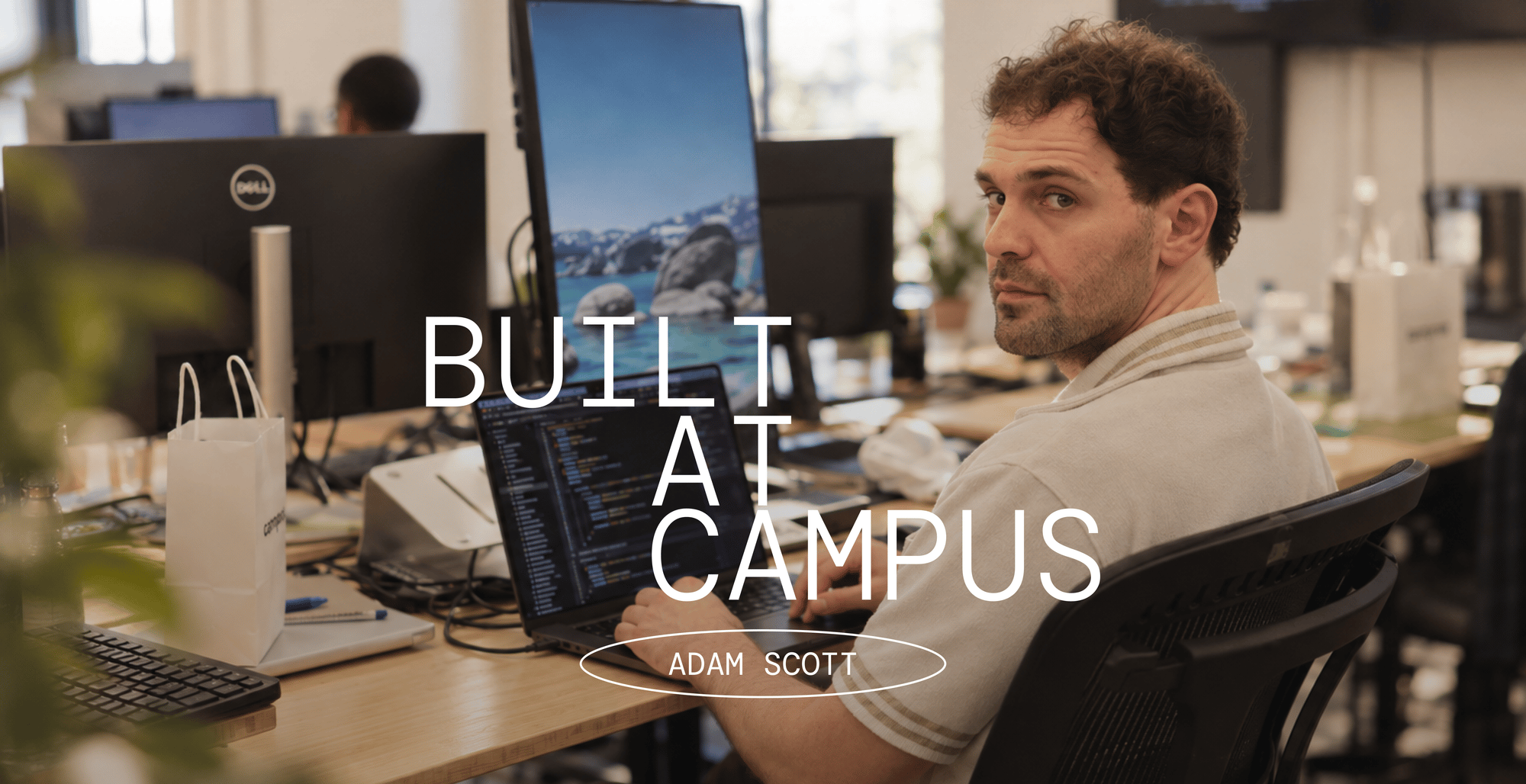
Most Built at Campus stories follow a graduate out into the world. This one goes the other direction.
Adam Scott came to Campus with no background in IT. Before he finished his Online Associate of Science in Information Technology, he had a student job fixing problems on the software students learn on. Today he's a full-stack software engineer at Campus, building it. This is Adam’s personal career story; Campus does not guarantee student jobs or employment after graduation.
The work he already knew
Before Campus, Adam built houses. His dad owned his own business, and Adam grew up in it — traveling for jobs, learning the trade on site rather than in a classroom. He was good at it, and years of it had taken a toll. "I was tired of the physical stress construction and homebuilding put on my body," he said.
Then something happened that had nothing to do with work. Adam lost two older brothers. During the pandemic, a decision he had deferred for years stopped feeling optional. He would go back and earn a degree.
Finding Campus
He had a place in mind: the school one of his brothers had gone to years earlier, which had worked out well for him. "I wanted to change something in my life," Adam said.
The program was fully online. Not long after he enrolled, Campus hired him into a student job supporting faculty and troubleshooting IT tickets on the platform. It was finally enough to let him stop building houses. He still worked seven days a week, picking up hay-baling near where he lived out in the country and taking his classes at night. Earning a degree without a commute wasn't a preference. It was the only way any of it fit.
What he felt going in wasn't doubt about the school so much as doubt about himself. "I was skeptical about going back to school at my age, but nothing talked me out of it. I was just nervous," he said. "It can be hard to go back to school when you've waited and didn't enroll right out of high school." The nerves lasted about two weeks. "Then I became excited because I felt like I was accomplishing something." He set a goal of straight A's and held it for the entire program.

Learning it all here
He started in IT knowing nothing about IT. Cloud administration was the first target, and he worked the certificate track toward it. But his student job had him on the Campus platform every day, opening tickets and closing them, and somewhere in there his interest turned. He stopped wanting to keep it running and started wanting to build it.
What he credits most, though, is the faculty. His instructors were working professionals who also taught elsewhere, and they turned out to be reachable in a way he hadn't expected. Of everything Adam talked about with us, the thing he kept coming back to was how available his professors were.
Two other people shaped the experience. Jackie, his success coach, kept his schedule straight and checked in whether or not there was a reason to. "I'm a self-motivated person," he said, "but she was still always there to support me." And Ralph, a fellow student around his age, took the same classes at the same time, which the two of them promptly turned into a contest. "Every term, we competed to see who could earn the certification first and who could pass first. It was awesome."
During his studies, Adam earned six industry certifications: CompTIA A+, Network+, and Security+; AWS Certified Cloud Practitioner and Solutions Architect; and LPI Linux Essentials.
What happened after that, he sums up in four words: "One thing led to another." But that really undersells what actually happened. He hadn’t enrolled to become an engineer. He’d enrolled to stop doing physical labor. “My original goal was to simply find something new,” he said. It didn’t stay that small.
"When I first enrolled, I didn't think it would lead to this," he said. "Once I started, everything snowballed and opened up a world of possibilities."
By the time he graduated, the platform he'd spent two years keeping running was the one he wanted to build, and Campus was where he wanted to stay. "I was loyal to Campus because I feel like Campus changed my life," he said. "That's where I wanted to be."
Building for the students behind him
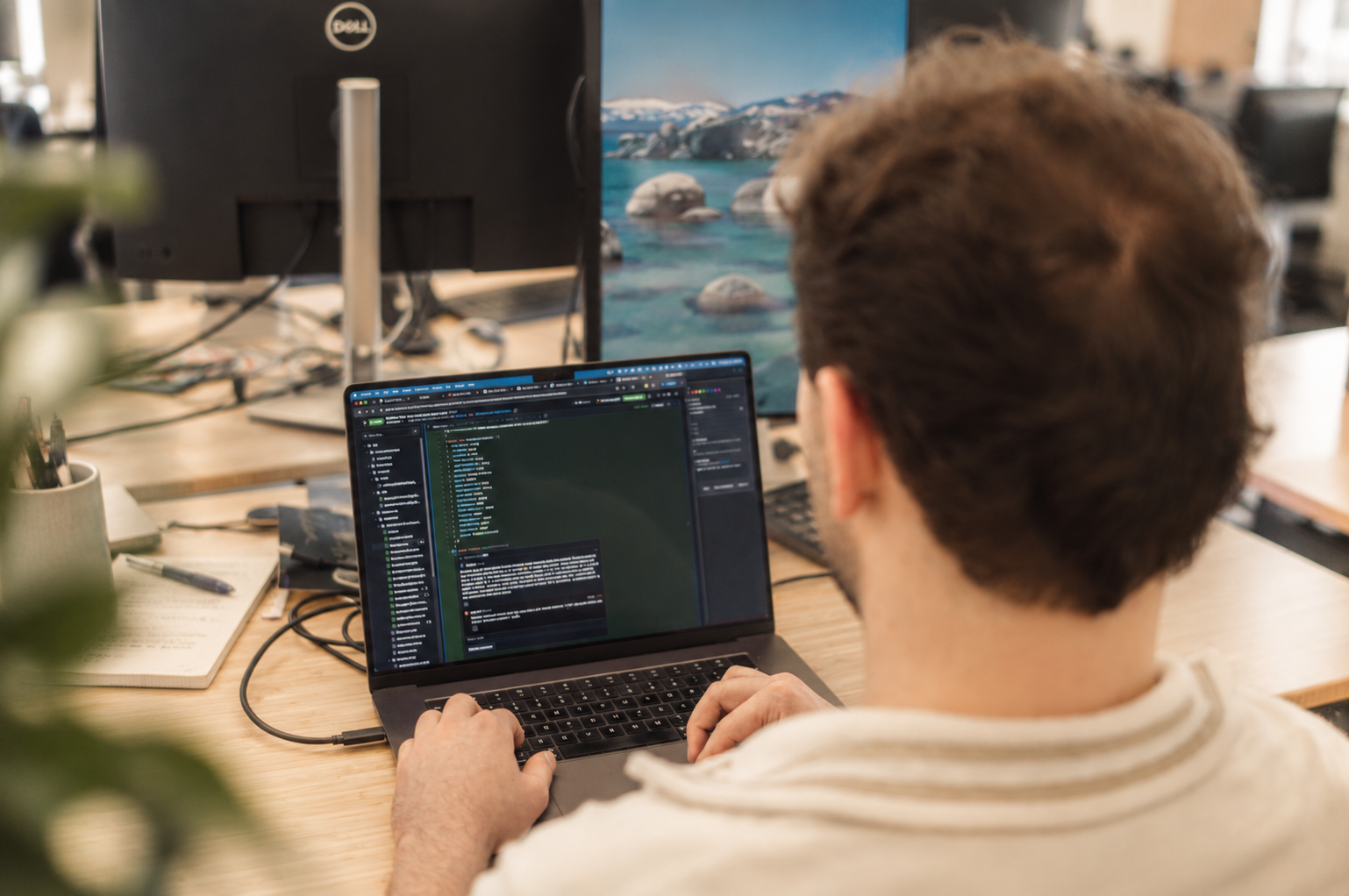
These days Adam works across the front end, back end, and database, most of it on the student experience. Most of that work is aimed at people sitting where he used to sit.
The longer-running project is the returning student portal, built for students who start college, step away because the timing isn't right, and decide later to return. Adam sees the portal as a way to welcome returning students and support their educational goals. Readmission is subject to Campus’s applicable requirements. Transfer admission and credit acceptance are determined by the receiving institution.
More recent is a team project: student report cards, a clean summary of what each person accomplished at the end of a term.
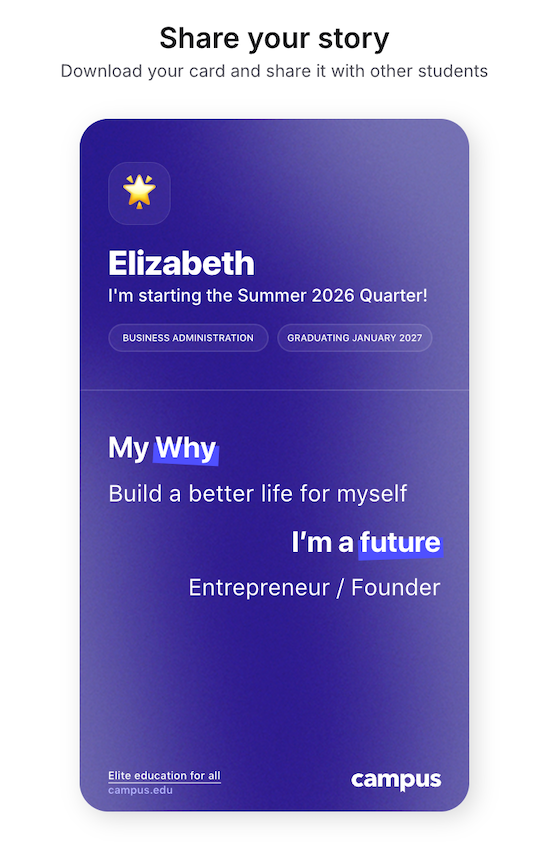
There's also Share Your Why, the cards students fill out at enrollment to explain what brought them here. That's the one he singles out.
"People share their reasons on social media. It can inspire them and give them the motivation to come back. I thought that was a really cool project."
He is, in other words, building the thing that built him. He doesn't put it that way. What he says is simpler.
"It feels good because I believe anybody can do it. If I could do it, anybody can go back to school and do it. It feels good to be able to give back. A lot of people don't receive opportunities like this, and Campus is giving people those opportunities. It feels good to watch other people succeed and do the same thing."
In his own words
We sat down with Adam for a longer conversation about the work, the program, and what he'd tell himself on day one. It's below, edited for length and clarity.

What does a full stack engineer actually do? How would you explain it to an 18-year-old who has no idea what it means?
A full stack engineer works on the front end, back end, and database. The front end is like the dining room of a restaurant. It includes the menus, buttons, and everything you see in the tab. The back end is like the kitchen: the orders, recipes, inventory, and who is allowed in. I would call the database the pantry. It's where everything is stored so that it can be found when it's needed.
When did you decide you wanted to become an engineer?
I started in the IT program. The certificates give you a look into engineering and can help give you that path. At first, I was looking at cloud administration. You learn a lot of engineering skills while earning those certificates, and I really enjoyed it. While I was working on the Campus platform, I decided I wanted to learn how to build the platform. One thing led to another.
What surprised you about Campus? What was different from what you expected?
Honestly, it was the experience my professors had. They all had incredible professional experience.
What part of the program challenged you the most?
The IT coursework was definitely the most challenging part. I didn't know anything about IT when I started, so there was a lot to take in. At the same time, IT works well online because all of the tools are available to you. You might think it would be difficult, but we had the right tools. It was stressful wondering whether I would earn all of the certifications because I really wanted them, and they meant a lot to me. That was the most challenging part, but everything worked out because the information and support I needed were always available to me.
Is there something specific from the IT program that still influences how you work as an engineer?
Yes. I think it's dealing with user-experience issues and asking questions like: How can we improve this? What's going on? What's happening? That carries over well into engineering. A lot of the time, you're building something without knowing exactly how it will work in the real world or what the user experience will be like. Having that perspective and knowing how to debug and test things is important. Honestly, I think any great engineer should start with IT. IT gives you a good foundation.
What does "Built at Campus" mean to you now that you're one of the people building Campus?
Built at Campus represents everything behind our mission and what Campus gave me. We have professors with incredible experience who helped me become someone special. Now, I'm building special things and helping other people go on to do special things, too.
Looking back at day one, what would you tell yourself now?
I would pat myself on the back because I'm proud of myself. I would also remind myself to give back. I feel like if I could do it, anybody can. One thing I always want to do is show people that anybody can do it.
About this story: Adam Scott is a graduate of Campus’s online Associate of Science in Information Technology program and a current Campus employee. This article reflects his personal experiences as a student and employee during the periods described. Individual experiences and outcomes vary. Campus does not guarantee student employment, employment after graduation, salary, career advancement, certification, readmission, or transfer. Certification requirements are established by the respective credentialing organizations, and transfer admission and credit acceptance are determined by the receiving institution.