

Program highlights
2 years
In 2 years you can have an Associate of Arts in Paralegal Studies.
100% live classes
Every class meets live with your professor and classmates.
$2,440/quarter
For students eligible for a full Pell Grant award, tuition costs may be fully covered.¹
¹ Pell Grant eligibility and award amounts are determined by the U.S. Department of Education. Awards may cover tuition but not all educational expenses.
ABA-approved
Vetted against a national standard for paralegal education.

Build a career in modern paralegal practice
Legal work is changing faster than most people outside it realize. Research that took an afternoon might now take twenty minutes. Document review that took a team takes a tool and someone who knows how to check it. What hasn't changed is that somebody has to be accountable — and increasingly, that somebody is the paralegal.
This program trains you for that job as it exists now: legal research, writing, and procedure across the practice areas paralegals actually work in. Professional responsibility — confidentiality, privilege, conflicts, and where attorney judgment takes over. And how to work alongside AI tools under supervision.
ABA-Approved for Quality and Trust
Our Paralegal Studies degree program is approved by the American Bar Association (ABA), a distinction that reflects rigorous national standards for paralegal education. This approval signals to students, and employers, that the program meets the ABA's standards for paralegal education, including standards related to curriculum, faculty, and institutional support.
What you'll learn
You'll build the skills legal teams rely on every day, in the practice areas where paralegals actually work.
You'll learn how to:
- Conduct legal research on traditional and AI-powered platforms — and verify and cite what you find
- Draft and manage legal documents to professional standards: memos, correspondence, pleadings, discovery
- Apply core legal concepts across family, criminal, corporate, contract, administrative, and real property law
- Handle professional responsibility in practice — confidentiality, privilege, conflicts of interest, and recognizing the line between paralegal work and work that requires attorney judgment
- Evaluate legal technology and AI tools: what they can do, where they fail, what has to be disclosed, and when a person needs to step in
- Manage case and file workflows, including deadlines and procedural timelines
- Communicate professionally with clients, courts, agencies, and opposing parties
By the end of the program you'll have developed practical skills commonly used in entry-level paralegal settings — and a foundation you can keep building on as you gain experience.
AI is built into the entire program
Rather than limiting AI to a single elective, we built it into the whole program.
You'll work with legal technology from your first quarter through the capstone, grounded in ABA Formal Opinion 512 — the ABA's own guidance on AI use in legal practice.
By graduation, you'll have completed the coursework required to be eligible to sit for the Westlaw Legal Research Certification exam and the Clio Certified Administrator exam.
You'll learn to use these tools responsibly in class — not on the job while someone watches.
Who the program is for
Two years, no legal background required. You'll learn the tools and workflows legal teams use now, and finish with an ABA-approved degree and a portfolio of practice-based work samples.
You want live classes, a cohort, and consistent access to your professors. Not a self-paced course you take alone at midnight. And you want to do it alongside professional and other commitments.
Most law schools require a bachelor's degree, so this isn't a direct route there. What it gives you is a foundation in legal research, writing, and reasoning, plus credits that may apply toward a bachelor's degree at a four-year institution. Our advisors can help you map that path.
Our classes meet live, on a schedule. If you want to move at your own pace with little contact, this isn't the program for you.
And this degree does not lead to a law license. Paralegals are not licensed to practice law. If practicing law is your goal, this is a first step on a longer path, not a substitute for it.
Where paralegals work
Paralegals and legal assistants work in:
- Law firms and legal services
- Corporate legal departments
- Local, state, and federal government agencies
- Finance and insurance
Career outcomes and salaries vary by experience, employer, and location, and employment is not guaranteed.
Program costs
Grants and other forms of tuition assistance are available to those who qualify. To discuss your individual eligibility, contact an admissions counselor.
Tuition and fees
- Admissions registration fee
- $0
- Enrollment deposit
- $20
- Full program tuition
- $19,520
- Books and supplies
- Included in tuition
- Total
- $19,540
Students enrolled in 7–12 credits per quarter are charged a flat tuition rate of $2,440. Students taking 6 credits or fewer are charged $200 per credit. Students enrolling in more than 12 credits are charged the flat rate of $2,440, plus $200 per credit for each additional credit above 12.
| Quarter | Academic year* | Calendar year** |
|---|---|---|
| Quarter 1 | $2,440 | $2,440 |
| Quarter 2 | $2,440 | $2,440 |
| Quarter 3 | $2,440 | $2,440 |
| Quarter 4 | — | $2,440 |
| Annual cost | $7,320 | $9,760 |
*Students completing three quarters per year will complete the program in 2.5 years.
**Most Campus students attend classes during all four quarters of the year.
A one-time $20 enrollment deposit may be required to reserve a student's seat in class. Refund eligibility and applicable terms vary by program and enrollment status.
Financial aid is available to those who qualify. Eligibility is determined through the FAFSA and may vary by student. Campus does not guarantee financial aid or student loan approval.
Meet your professors
You'll benefit from access to professors who also teach at some of the best colleges in the country, including Columbia, Northwestern, and more. Campus professors are subject experts who bring a variety of online and industry experience to the virtual classroom. Elevate your online learning experience through dynamic live sessions and optional office hours each week.
Learn more about our world-class faculty.



Program courses
Degree overview
Students in the online associate degree in Paralegal Studies must complete 96 quarter credits to earn their degree. Below is an example sequence of courses based on an eight-quarter completion schedule.
Each quarter is 11 weeks long, including 10 weeks of live instruction and one final assessment week. Students typically enroll in 12 credits per quarter when attending full time. Completion time may vary based on transfer credits and course load.

Course titles and sequencing are subject to change. The curriculum includes coursework in legal research and writing, professional responsibility, substantive law across family, criminal, corporate, contract, administrative, and real property practice areas, e-discovery, and legal operations and AI, culminating in a capstone.
Core paralegal coursework (64 credits)
This course introduces students to the structure and operation of the legal system and the professional role of the paralegal within modern legal practice. Emphasis is placed on understanding legal processes, professional responsibilities, and paralegal relationships with attorneys, clients, and courts. Students develop foundational skills in legal reasoning, terminology, organization, and professional communication through applied projects including analyzing legal documents, organizing case information, and tracking procedural tasks. The course also introduces ethical boundaries, confidentiality, and the evolving role of technology in legal service delivery. Students complete the coursework required to be eligible to sit for the Clio Certified Administrator exam across the quarter.
Course learning outcomes (CLOs)
Upon successful completion of this course, students will be able to:
- Identify the structure and function of the federal and state legal systems
- Analyze the role of the paralegal in relation to attorneys, clients, and courts
- Apply foundational legal terminology and concepts in a professional context
- Organize legal information, case files, and procedural tracking systems
- Demonstrate professionalism, confidentiality, and ethical awareness in legal practice, including technology-assisted settings
This course examines the ethical principles and professional responsibility standards that govern paralegal practice. Students move from general awareness of ethical boundaries to rigorous analysis and application of professional conduct rules in realistic legal settings. Emphasis is placed on confidentiality, conflicts of interest, supervision by attorneys, unauthorized practice of law, and the paralegal’s obligations when ethical rules and practical pressures collide. A significant integrated portion of the course addresses ethics in the context of legal technology and artificial intelligence, guided by ABA Formal Opinion 512 (2024).
Course learning outcomes (CLOs)
Upon successful completion of this course, students will be able to:
- Identify ethical rules and professional responsibility standards relevant to paralegal
- Analyze ethical issues in practical legal workplace scenarios, including technology-assisted contexts
- Apply ethical reasoning to questions involving confidentiality, supervision, conflicts of interest, and unauthorized practice
- Evaluate the ethical obligations that arise specifically from the use of AI and other legal technologies
- Demonstrate sound professional judgment and integrity in both traditional and technology-assisted practice
This course introduces students to the reading, interpretation, and analysis of the legal texts central to paralegal work. Emphasis is placed on understanding how meaning is derived from statutes, cases, regulations, contracts, court rules, and other legal documents through close reading and structured reasoning rather than memorization of substantive law. Students develop foundational skills in identifying legal issues, interpreting terminology, extracting rules, recognizing ambiguity, and comparing sources of authority. The course also introduces the interpretive limitations of AI-generated legal summaries.
Course learning outcomes (CLOs)
Upon successful completion of this course, students will be able to:
- Identify key features of statutes, cases, regulations, and other legal texts
- Analyze legal language, ambiguity, and context in written authorities
- Apply basic principles of legal reasoning and statutory interpretation to legal materials
- Organize legal rules and authorities for clear explanation and comparison, including by weight and currency
- Demonstrate accurate, precise, and professionally appropriate interpretation of legal texts, including critical evaluation of AI-generated legal summaries
This course develops foundational legal research skills with emphasis on analytical reasoning, authority evaluation, and the research strategies used in professional legal practice. Students learn to locate, evaluate, and deploy primary and secondary legal sources using both traditional and electronic research platforms. Emphasis is placed on research planning, issue identification, citation fundamentals, and verification of legal authority, including critical evaluation of AI-powered legal research tools. Students complete the coursework required to be eligible to sit for the Westlaw Legal Research Certification exam within this course.
Course learning outcomes (CLOs)
Upon successful completion of this course, students will be able to:
- Identify appropriate primary and secondary sources for a range of legal research problems.
- Analyze the relevance, currency, and authority of statutes, regulations, cases, and administrative materials.
- Apply research strategies, citation standards, and verification methods to legal questions.
- Evaluate the accuracy and limitations of technology-assisted and AI-powered legal research tools.
- Demonstrate accurate, efficient, and professionally documented legal research, including proper use and verification of electronic research platforms.
This course develops clear, accurate, and professionally effective legal writing skills essential to paralegal practice. Students apply legal reasoning, research, and interpretation skills in written form, drafting common legal documents and correspondence including memoranda, pleadings, and client communications. The course gives particular attention to responsible drafting in technology-assisted environments. Students complete an AI Use Disclosure with each major writing assignment, reinforcing the ethical framework established in LGL 105.
Course learning outcomes (CLOs)
Upon successful completion of this course, students will be able to:
- Identify the conventions, purposes, and standards of professional legal writing across document types
- Analyze writing tasks for audience, tone, purpose, structure, and ethical obligations
- Apply legal research and analysis in well-organized, accurately cited written documents and correspondence
- Evaluate and revise drafted legal work, including AI-assisted drafts, using professional standards
- Demonstrate professional drafting, revision, citation, and disclosure practices consistent with legal workplace expectations
This course introduces students to the legal principles, procedures, and issues commonly encountered in family law practice. Emphasis is placed on the legal framework governing marriage, divorce, child custody, support, adoption, and related domestic matters. Equal emphasis is given to the human dimension of this practice: family law clients are navigating some of the most difficult circumstances of their lives, and the paralegal’s ability to maintain professionalism and genuine attentiveness is as important as procedural competence.
Course learning outcomes (CLOs)
Upon successful completion of this course, students will be able to:
- Identify major legal issues, proceedings, and procedural stages in family law
- Analyze family law fact patterns, documents, and procedural developments
- Apply foundational family law concepts to document preparation and case-support tasks
- Organize family law files, client communications, and procedural timelines
- Demonstrate professionalism, ethical sensitivity, and confidentiality in domestic matters
This course introduces students to the structure, terminology, and operation of criminal law and criminal procedure within the American legal system. Emphasis is placed on understanding the classification of offenses, elements of crimes, stages of prosecution, and the constitutional framework that governs criminal proceedings. The course examines both prosecution- and defense-side practice, emphasizing the paralegal’s responsibility to accuracy and procedural integrity regardless of which side they are assisting.
Course learning outcomes (CLOs)
Upon successful completion of this course, students will be able to:
- Identify key concepts, classifications, constitutional principles, and procedures in criminal law
- Analyze criminal case materials, charging documents, and procedural developments
- Apply foundational criminal law concepts to legal support tasks on both prosecution and defense sides
- Organize criminal case files, timelines, and court-related documents
- Demonstrate professionalism, accuracy, and ethical awareness in criminal matters, including appropriate handling of sensitive case information
This course introduces students to the legal concepts, structures, and practices that govern business entities and corporate operations. Emphasis is placed on understanding the formation, organization, and governance of corporations and other business entities, as well as the paralegal’s role in supporting transactional and governance-related legal work. This course serves as conceptual preparation for LGL 245 and LGL 255.
Course learning outcomes (CLOs)
Upon successful completion of this course, students will be able to:
- Identify major business entity forms, governance structures, and corporate formalities
- Analyze organizational documents, compliance requirements, and corporate records
- Apply foundational corporate concepts to legal support work in business settings
- Organize entity records, compliance materials, and governance-related documents
- Demonstrate professionalism, accuracy, and ethical judgment in corporate legal practice, including technology-assisted environments
This course introduces students to the legal principles and procedural frameworks that govern administrative agencies and regulatory decision-making. Emphasis is placed on understanding how agencies create, interpret, and enforce regulations, and on the relationship between administrative law and legislative, executive, and judicial authority. Students examine rulemaking, adjudication, compliance, licensing, and enforcement processes with attention to the practical role of the paralegal in agency-related matters.
Course learning outcomes (CLOs)
Upon successful completion of this course, students will be able to:
- Identify foundational principles of contract law and the essential provisions of common agreements
- Analyze contract language for meaning, clarity, legal effect, and potential risk
- Apply contract concepts to review, interpretation, and legal support tasks
- Organize contract documents, correspondence, and related legal materials
- Demonstrate careful, professional judgment in contract-related work, including critical evaluation of AI-assisted contract review tools
This course introduces students to the legal, procedural, and technological framework governing electronically stored information (ESI) in litigation and regulatory matters. Organized around the Electronic Discovery Reference Model (EDRM), the course develops sequential mastery of each stage of the e-discovery lifecycle from information governance and identification through collection, processing, review, production, and presentation. A significant focus is the integration of AI tools into e-discovery workflows: students examine technology-assisted review, predictive coding, and workflow management platforms critically, evaluating each for functionality, human oversight requirements, and ethical compliance. This course establishes the ESI literacy and EDRM fluency.
Course learning outcomes (CLOs)
Upon successful completion of this course, students will be able to:
- Identify the legal framework governing electronically stored information, including relevant Federal Rules of Civil Procedure and the professional obligations they create for litigation support teams
- Analyze the stages of the EDRM lifecycle and the paralegal’s role at each stage, from information governance and identification through review, production, and presentation
- Apply EDRM concepts and ESI procedures to a single simulated case matter, producing the documentation associated with each major stage of the e-discovery process
- Evaluate AI-assisted review tools, predictive coding systems, and workflow management platforms for functionality, accuracy, supervision requirements, and ethical compliance
- Demonstrate professional judgment, accuracy, and ethical responsibility in e-discovery practice, including recognition of privilege, confidentiality obligations, and the limits of automated review
This course introduces students to the legal principles and procedural frameworks that govern administrative agencies and regulatory decision-making. Emphasis is placed on understanding how agencies create, interpret, and enforce regulations, and on the relationship between administrative law and legislative, executive, and judicial authority. Students examine rulemaking, adjudication, compliance, licensing, and enforcement processes with attention to the practical role of the paralegal in agency-related matters.
Course learning outcomes (CLOs)
Upon successful completion of this course, students will be able to:
- Identify the functions, authority, and procedural structures of administrative agencies
- Analyze agency procedures, regulations, and administrative actions for legal effect and procedural compliance
- Apply administrative law concepts to legal support tasks in agency-related matters
- Organize administrative materials, filings, and procedural requirements
- Demonstrate professionalism, accuracy, and awareness of due process considerations in administrative and regulatory practice
This course introduces students to the legal concepts, principles, and frameworks governing real property in the United States. Emphasis is placed on understanding foundational real property doctrine through close reading and structured reasoning: the nature of real property and the bundle of rights, freehold estates and future interests, concurrent ownership forms, deeds and covenants of title, the recording system and chain of title, liens and encumbrances, easements and servitudes, leasehold estates and landlord-tenant relationships, and land use and zoning frameworks. All concepts are grounded in common law principles applicable nationally, with State of Morrow used as the composite procedural anchor where needed.
Course learning outcomes (CLOs)
Upon successful completion of this course, students will be able to:
- Identify the principal estates, ownership interests, and legal frameworks governing real property under common law principles applicable nationally
- Analyze real property fact patterns, documents, and legal descriptions for ownership rights, encumbrances, and title issues
- Apply foundational real property concepts to legal support tasks including deed review, encumbrance analysis, and title issue identification
- Organize real property documents, title records, encumbrance information, and ownership materials for attorney review
- Demonstrate professional judgment, accuracy, and ethical responsibility in real property matters, including appropriate handling of title issues, client communications, and technology-assisted property review tools
This course introduces the operational systems, technologies, and workflow processes that support efficient, ethical, and high-quality legal service delivery in contemporary practice. Students work as legal operations paralegals for Campus Legal Solutions across four simulated client environments: a solo/small firm, a mid-size regional firm, a Big Law firm, and an in-house legal department. Across the quarter, students evaluate tools, design workflows, draft governance policy, and apply responsible AI practices, including ABA Formal Opinion 512 disclosure and verification obligations.
Course learning outcomes (CLOs)
Upon successful completion of this course, students will be able to:
- Identify core legal operations systems, workflows, and the principal categories of AI tools in legal practice
- Analyze the opportunities, risks, and limitations of legal technology and AI at each stage of legal work
- Apply legal operations concepts and technology tools to support legal service delivery effectively across practice settings of varying size and structure
- Evaluate new legal technology tools for functionality, accuracy, supervision requirements, and ethical compliance
- Demonstrate responsible, ethical, and professionally informed use of technology throughout legal operations, including compliance with ABA Formal Opinion 512 disclosure and verification obligations
This course develops applied knowledge and practical skills in employment law, examining the legal regulation of the employment relationship across its full arc: hiring practices, wage and hour compliance, anti-discrimination and anti-harassment frameworks, leave entitlements, discipline, and termination. Students develop skills in document review, fact organization, timeline development, and case preparation, including matters before the EEOC, Department of Labor, and state human rights agencies.
Course learning outcomes (CLOs)
Upon successful completion of this course, students will be able to:
- Identify core legal issues, doctrines, and agency frameworks governing the employment relationship.
- Analyze employment-related facts, documents, workplace records, and agency processes.
- Apply employment law concepts to legal support, case preparation, and agency matter tasks.
- Organize workplace records, timelines, supporting materials, and case files in employment matters
- Demonstrate professionalism, confidentiality, and sound ethical judgment in handling sensitive employment law matters
This course develops applied knowledge and practical skills in tort law, the body of civil law governing liability for harm to persons, property, and economic interests. Emphasis is placed on negligence, intentional torts, strict liability, causation, defenses, and damages as they arise in litigation practice. Students work with pleadings, incident reports, medical records, expert materials, and damages documentation commonly used in personal injury and civil liability matters.
Course learning outcomes (CLOs)
Upon successful completion of this course, students will be able to:
- Identify major tort theories, elements, defenses, and damages issues in civil liability practice
- Analyze tort fact patterns, pleadings, records, and litigation materials for legal issues and case-development needs
- Apply tort law concepts to legal support, case organization, and litigation-preparation tasks
- Organize incident reports, medical records, damages documentation, and case files in tort matters
- Demonstrate accuracy, professional responsibility, and sound judgment in tort-related litigation support
This course develops the practical skills used in litigation support from discovery through trial readiness. Emphasis is placed on the paralegal’s role in managing discovery processes, drafting and responding to written discovery, organizing evidence, coordinating witnesses, and supporting attorneys in trial preparation. A sustained focus of the course is e-discovery: the management, processing, review, and production of electronically stored information, including AI-assisted document review platforms.
Course learning outcomes (CLOs)
Upon successful completion of this course, students will be able to:
- Identify major discovery tools, pretrial procedures, and the stages of civil litigation preparation
- Analyze litigation-support needs across discovery, evidence organization, and trial preparation
- Apply procedural requirements and organizational frameworks to discovery and trial-support tasks
- Organize evidence, witness materials, exhibit lists, and pretrial files effectively and systematically
- Demonstrate ethical and professional responsibility in litigation practice, including responsible use of e-discovery and AI-assisted document review tools
The online student experience
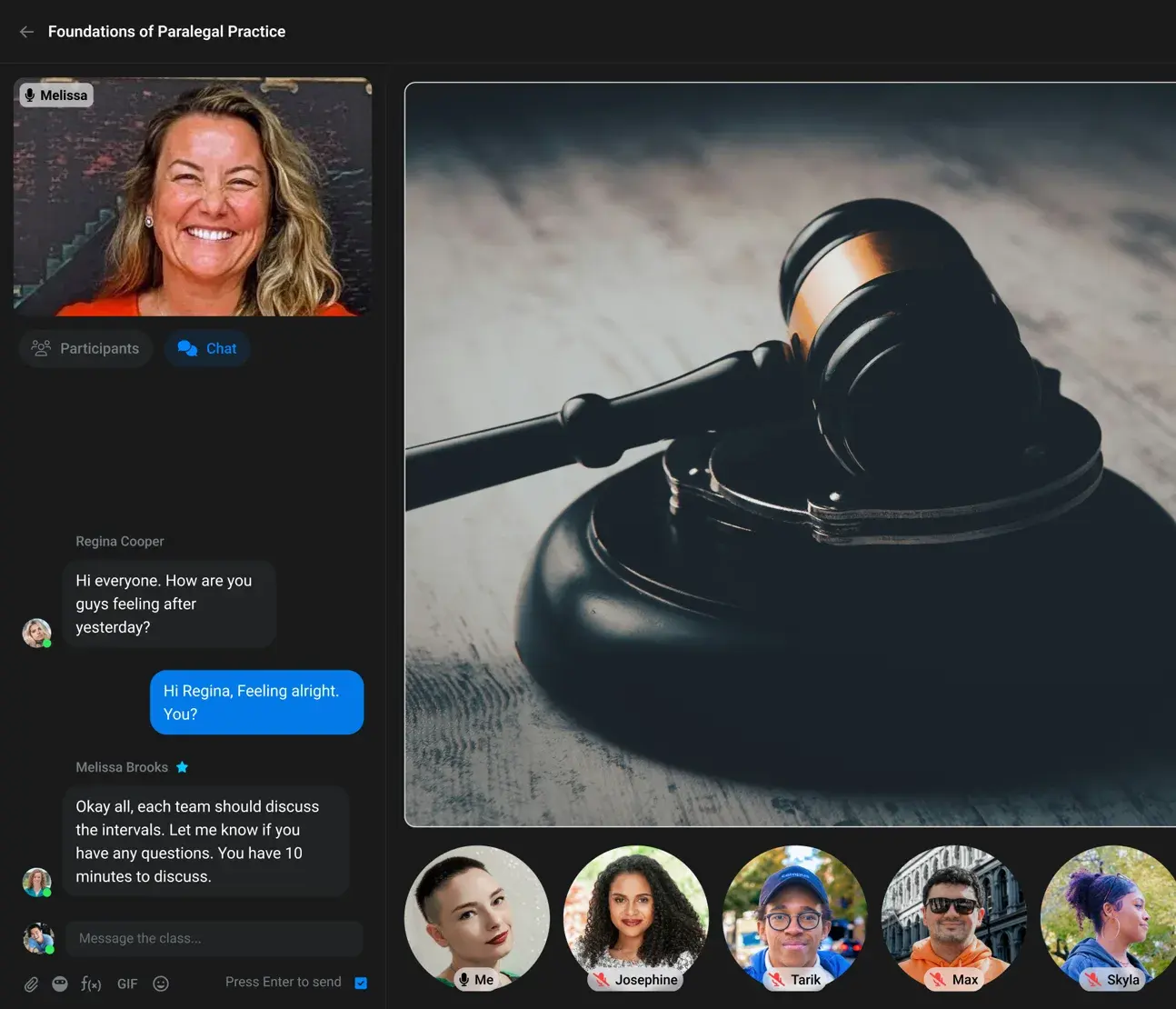
All classes in the Campus Scholars programs meet live so you can interact directly with professors and peers through discussions, breakout sessions, and collaborative work.
Students have unlimited access to one-on-one math and writing tutoring at no additional cost, with support available around the clock.
Faculty hold live weekly office hours so you can ask questions, build relationships, and deepen your understanding of course material.
Before classes begin, you will be matched with a personal success coach who will help you set and work toward your academic and professional goals.
Students who need them receive a laptop and mobile Wi-Fi access at no additional cost. E-textbooks and digital course materials are also included.
FAQ
Have questions? Talk to admissions.
Our admissions advisors are here to answer questions and help you navigate the admissions process.
Apply now for the next term
If you're savvy, ambitious, and looking to knock out the first two years of college while learning from some of the best professors in the country, we should talk.