
Donald Rarick
Captain
U.S. Air Force


In 2 years, you can have an Associate of Science in Cybersecurity.
Every class meets live with your professor and classmates.
For students eligible for a full Pell Grant award, tuition costs may be fully covered.1
¹ Pell Grant eligibility and award amounts are determined by the U.S. Department of Education. Awards may cover tuition but not all educational expenses.
Our program prepares you for several in-demand certifications that employers are looking for.
Hospitals, banks, schools, and government agencies all run on systems someone has to protect. More and more, that work involves AI: using it to find threats faster, and defending against attacks that use it. Campus's Associate of Science in Cybersecurity is designed to build foundational IT and security knowledge for students pursuing technology careers. Specialized cybersecurity roles may require additional education, certifications, and related work experience.
Many people get into cybersecurity through hands-on IT roles like IT support and network support, and build the experience that security positions ask for. One longer-term job target is information security analyst which commonly requires a bachelor's degree. The U.S. Bureau of Labor Statistics lists it among the fastest-growing occupations in the country, projected to grow 21% from 2025 to 2035, six times the 3.5% average for all occupations. The median annual wage is $129,180 (BLS, May 2025). BLS notes these roles typically require a bachelor's degree and related IT experience.1
1 Job growth and salary figures are based on Bureau of Labor Statistics data, not Campus graduate outcomes. Real-world outcomes vary with experience, industry, location, individual skill, and economic conditions. BLS median wages reflect workers at all experience levels and are not entry-level wages. Campus does not guarantee employment, salary, or job growth.
You'll build the IT foundation and security skills that cybersecurity teams rely on. You'll learn how to:
By the end of the program, you'll have opportunities to develop practical skills commonly used in entry-level IT and security settings, and a foundation you can keep building on through experience, certifications, or a bachelor's degree.
Preparation for industry certification exams is built into your coursework. The program includes content aligned to the following certification exams:
Students who earn a C or higher in both the final course grade and the final exam for a qualifying course are eligible for a Campus-funded exam voucher, subject to the additional eligibility requirements, limits, and covered exams identified in the voucher disclosure.* Earning a certification requires passing the applicable certification exam(s) and meeting the certification provider's requirements.
*See the degree-specific voucher policy for qualifying courses, covered exams, eligibility requirements, and voucher limits.
AI shows up from your first year through your capstone, and we teach both sides of it.
Using AI in security work. Learn how AI works in Intro to AI, then how it's changing threat detection and incident response in AI in Cybersecurity. In Network Security & Defense, you'll check AI-assisted recommendations against your own lab test results. In the capstone, you'll use an AI or automation tool on a project task, verify its output against independent evidence, and document its limits.
Defending against AI-driven threats. Starting in Introduction to Cybersecurity, you'll learn to recognize AI-generated deception, like phishing and social engineering, and how to respond.
The goal is judgment: knowing what these tools do well, where they get it wrong, and when a person has to make the call.
Every organization that runs on technology needs people who can keep it running and keep it secure. Cybersecurity work spans entry-level technology support through specialized security and management roles. The examples below show roles people may pursue at different stages.
An associate degree in Cybersecurity can prepare you for entry-level technology roles in IT support and network support, where many people build the experience security roles ask for. Depending on experience, certifications, and employer requirements, graduates may pursue roles such as:
Professionals may pursue roles such as:
*Career opportunities vary by education, experience, certifications, employer requirements, and location. Employment is not guaranteed. The linked U.S. Bureau of Labor Statistics (BLS) profiles describe occupations generally, not Campus graduate outcomes. BLS does not list SOC analyst as a separate occupation; its Information Security Analysts profile is the closest match.
Grants and other forms of tuition assistance are available to those who qualify. To find out what you're eligible for, contact an admissions counselor.
Students enrolled in 7 to 12 credits per quarter are charged a flat tuition rate of $2,440. Students taking 6 credits or fewer are charged $200 per credit. Students enrolling in more than 12 credits are charged the flat rate of $2,440, plus $200 per credit for each additional credit above 12.
| Quarter | Academic Year* | Calendar Year** |
|---|---|---|
| Quarter 1 | $2,440 | $2,440 |
| Quarter 2 | $2,440 | $2,440 |
| Quarter 3 | $2,440 | $2,440 |
| Quarter 4 | - | $2,440 |
| Annual Cost | $7,320 | $9,760 |
*Students completing three quarters per year will complete the program in 2.5 years.
**Most Campus students attend classes during all four quarters of the year.
A one-time $20 enrollment deposit may be required to reserve a student's seat in class. Refund eligibility and applicable terms vary by program and enrollment status. Additional details regarding enrollment deposit terms, deferrals, and refund conditions can be found in the Campus Catalog.
Financial aid is available to those who qualify. Eligibility is determined through the Free Application for Federal Student Aid (FAFSA) and other applicable requirements. Awards may vary based on financial need, program, enrollment status, and availability of funds. Campus does not guarantee financial aid or student loan approval.
You'll learn from cybersecurity practitioners who also teach at universities including the University of Maryland and Cornell. They bring what they do professionally into the live classroom, with dynamic live sessions and optional office hours each week.
Learn more about our world-class faculty.
Captain
U.S. Air Force

Also teaches at:
UC Davis

Also teaches at:
St. John's
Students in the online Associate of Science in Cybersecurity must complete 96 quarter credits to earn their degree: 32 in general education and 64 in core cybersecurity and IT coursework. Below is an example sequence of courses based on an eight-quarter completion schedule.
Quarters are 12 weeks long, including one “syllabus” week, 10 weeks of live instruction, and one final assessment week. Students typically enroll in 12 credits per quarter when attending full time. Completion time may vary based on transfer credits and course load.
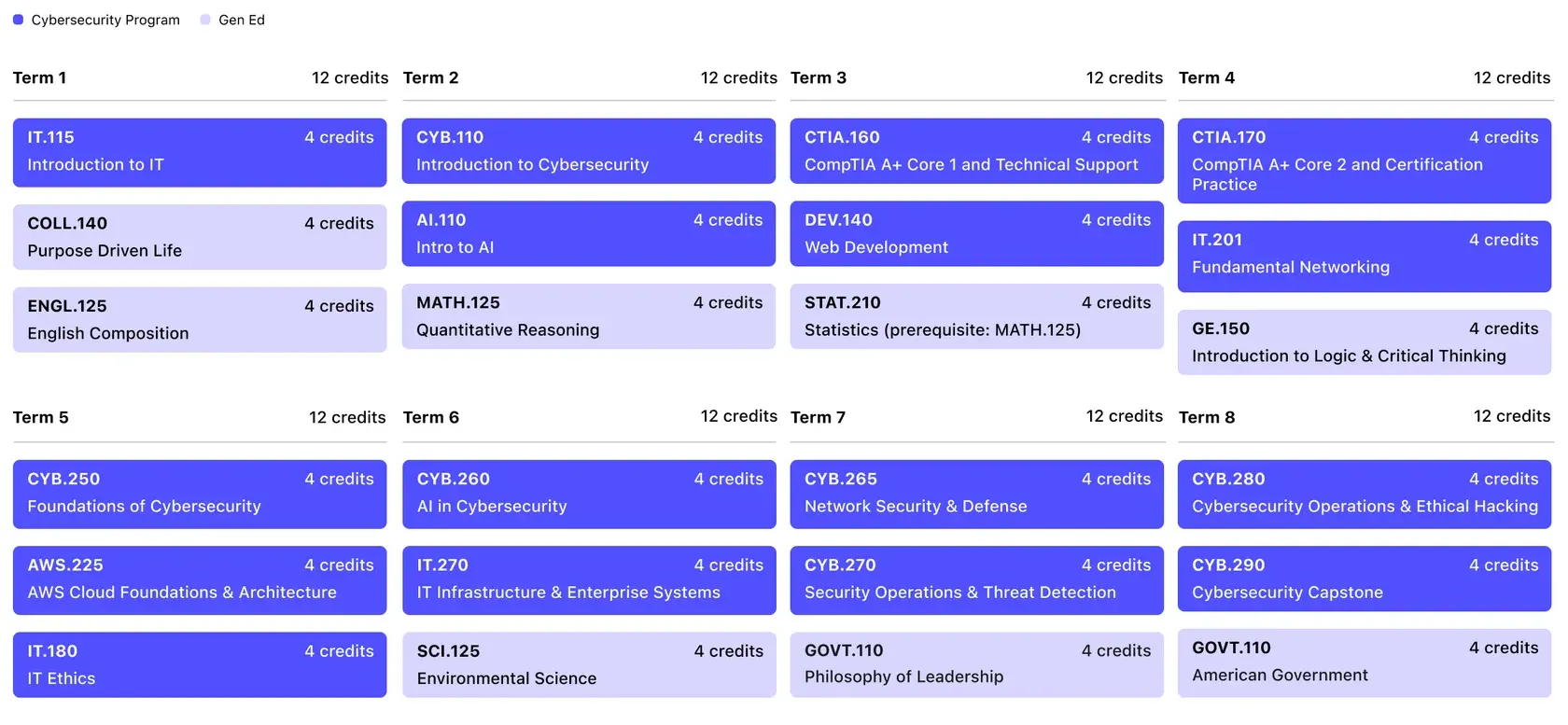
Course titles and sequencing are subject to change. The curriculum includes coursework in IT fundamentals, networking, cloud infrastructure, artificial intelligence, ethics and data privacy, network security and defense, security operations and threat detection, and ethical hacking, culminating in a capstone project.
This course provides an overview of the core concepts and tools in modern information technology. Students will explore hardware, software, networks, cybersecurity fundamentals, and emerging trends in IT. Emphasis is placed on understanding how IT supports business operations and decision-making.
This course introduces the IT systems, cybersecurity concepts, and security principles used to protect information, devices, accounts, and organizations. Students examine how hardware, software, operating systems, networks, and data interact; distinguish threats, vulnerabilities, and risks; and apply confidentiality, integrity, availability, least privilege, and defense in depth to introductory scenarios. Guided activities develop basic safeguards, risk assessment, and security reporting skills. Ethical conduct, privacy, AI-enabled threats, and responsible AI use establish a foundation for later study in technical cybersecurity courses.
Explore the fundamentals of artificial intelligence and its impact on society, technology, and everyday life. This course introduces core concepts such as machine learning, generative AI, and data-driven systems in a non-technical, accessible way. Students will learn how AI works, what it can and cannot do, and how it is applied across various fields including healthcare, education, media, and business. The course also examines important ethical considerations, including bias, privacy, and the responsible use of AI. By addressing key questions about how AI functions, what it is used for, and when it should be applied, students will develop a well-rounded understanding of this rapidly evolving technology.
This course provides an overview of topics covered in CompTIA A+ certification exams. Topics include an overview of CompTIA A+ exam objectives including device hardware components, operating system configuration, networking basics, security practices, and troubleshooting. This course prepares students for the exam CompTIA A+ certification exams. Certification is not included in the course but is supported through Campus's Certification Voucher Program.
This course provides an overview of objectives covered in the CompTIA A+ Core 2 certification exam. Students learn to maintain, troubleshoot, and secure a variety of operating system environments. The course explores the operational procedures common to most professional environments. Through a mix of independent study, practice exams, and instructor-guided coaching, students prepare for the CompTIA A+ certification exams. This course prepares students for the exam CompTIA A+ certification exams. Certification is not included in the course but is supported through Campus's Certification Voucher Program.
Students learn the foundational skills of web development including client-server communication, HTML, CSS, and JavaScript. The course emphasizes building accessible, responsive, and user-friendly web pages for modern devices, introducing deployment practices, no-code hosting platforms, information hierarchies, visual data encoding, and basic Gestalt design principles. All tools and materials are free or no-cost. The course culminates in a personal portfolio project deployed to the web.
This course focuses on providing the skills and knowledge necessary to troubleshoot, configure, and manage common network wireless and wired devices, establish basic network design and connectivity, understand and maintain network documentation, identify network limitations and weaknesses, and implement network security, standards, and protocols. Concepts from this course prepare students for the successful completion of the CompTIA Network+ certification exam. This course prepares students for the CompTIA Network+ exam. Certification is not included in the course but is supported through Campus's Certification Voucher Program. (Prerequisite: CTIA.160 or successful completion of the CompTIA A+ certification)
Core security concepts, threats, vulnerabilities, and defensive strategies — aligned to the CompTIA Security+ (SY0-701) exam.
This course introduces the AWS Cloud environment for cloud administration. Students learn about the AWS Cloud's global infrastructure, billing and pricing models, security practices, and review the core services available in AWS Cloud. Students also gain an introduction to cloud architecture principles. This class is mapped to the Amazon AWS Certified Cloud Practitioner exam objectives. Additionally, in this course, students step deeper into the AWS Cloud services to apply optimization and best practices to support a well-architected environment. This class explores high availability services, automation, decoupling, and scaling. This class is mapped to outcomes found in the Amazon AWS Certified Solutions Architect exam. This course prepares students for the AWS Certified Solutions Architect exam. Certification is not included in the course but is supported through Campus's Certification Voucher Program.
Legal frameworks, data privacy, responsible disclosure, and the professional standards that govern technology work — with particular attention to cybersecurity contexts.
How artificial intelligence is reshaping threat detection, security operations, and incident response. Covers machine learning fundamentals for security practitioners, AI-powered SIEM platforms, and the ethical implications of automated security systems.
This course explores the structure and function of IT systems within enterprise environments, focusing on the frameworks, policies, and practices that ensure operational continuity and compliance. Topics include IT service management (ITSM), ticketing systems, incident response planning, and standards such as ISO/IEC and NIST frameworks. Students will develop a theoretical understanding of how enterprise infrastructure supports large-scale technology operations, emphasizing governance, scalability, and the role of IT in strategic business alignment.
This course applies networking and cybersecurity principles to the defense of organizational networks. Students use network architectures, protocols, and traffic flows to evaluate threats and implement layered protections for wired, wireless, remote-access, and cloud-connected environments. In authorized labs, students configure segmentation, firewalls, access controls, and intrusion detection or prevention tools; apply cryptographic protections to network communications; and test the effectiveness of defenses. Emphasis is placed on preserving required connectivity, troubleshooting configurations, analyzing evidence, and documenting risk-reduction recommendations. Students validate AI-assisted recommendations before incorporating them into defensive changes.
Day-to-day work of security professionals: SIEM platforms, log analysis, threat intelligence, alert triage, and incident response procedures — aligned to the CompTIA CySA+ (CS0-003) exam.
How to think like an adversary: reconnaissance, scanning, exploitation, and professional penetration testing methodology — aligned to the EC-Council CEH exam.
This culminating course integrates IT systems, networking, cybersecurity principles, cloud, and responsible AI competencies through a scoped project for a simulated organization. Students assess an environment, prioritize risks, implement and validate selected defenses, and demonstrate incident analysis and response within an authorized scope. Students manage milestones, incorporate feedback, and produce an individual portfolio of technical artifacts, test results, risk-reduction recommendations, and a presentation for technical and nontechnical audiences.
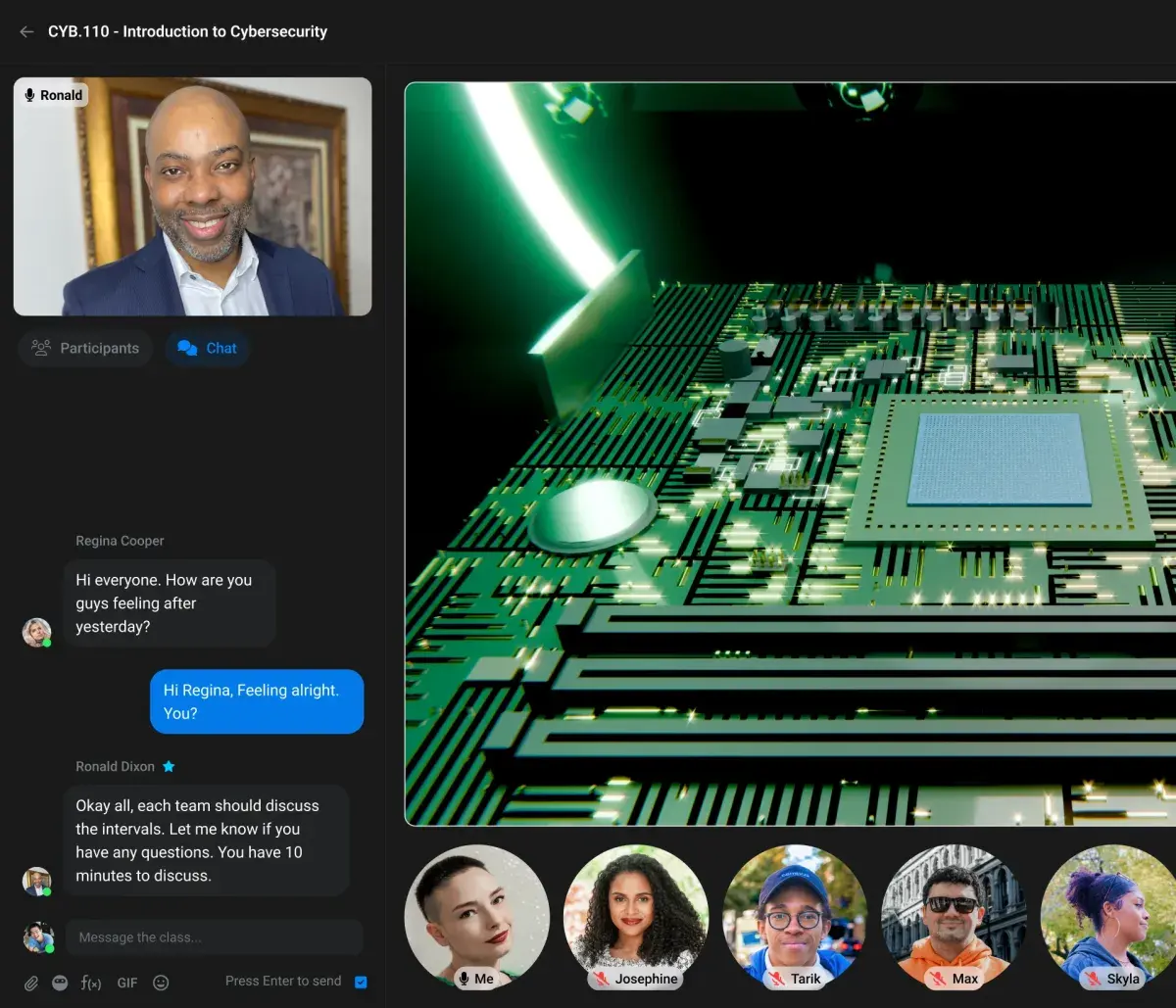
All classes in the Campus online degree programs are live so that you can directly interact with professors and peers. We keep things engaging by holding lively discussions and debates, breakout sessions, forums, and more.
It depends on where you're starting. If you're new to IT, an associate degree gives you a structured foundation, live instruction, certification exam prep and credits you can build on toward a bachelor's degree. If you already work in IT, certifications alone may get you further, faster. The right choice depends on your goals, time and budget.
It's challenging, and it's designed so you can start from the fundamentals. You'll learn how computers, networks and operating systems work before moving into security. Expect weekly study, hands-on lab practice and participation in live classes. No prior IT experience is required, but the coursework takes real effort.
Two years, full time. The program is 96 quarter credits over eight quarters, at 12 credits per quarter. Each quarter is 12 weeks: one “syllabus” week, 10 weeks of live instruction, and one final assessment week. Transfer credits or a lighter course load can change your timeline.
There's no single required degree. BLS reports that information security analysts typically need a bachelor's degree in a computer-related field, while computer network support specialists typically need an associate degree. Many people start with an associate degree and IT experience, then keep building through certifications or a bachelor's.
Not always. Some entry-level IT support roles hire based on certifications and demonstrated skills. A degree adds structure, instructors, a broader foundation and potential credits toward a bachelor's degree, which many security analyst roles typically require.
An associate degree can prepare you for entry-level roles such as IT support specialist and computer network support specialist, which are common starting points into cybersecurity. Roles like SOC analyst or information security analyst are longer-term goals that typically require additional experience, certifications or a bachelor's degree. Employment is not guaranteed.
Cybersecurity work includes protecting accounts and networks, monitoring systems for threats, assessing risk, investigating incidents and explaining findings to the people who need to act. Graduates may work in IT and security roles across technology, finance, healthcare, government and education. Career outcomes vary by employer, experience and location.
BLS does not report a salary specifically for holders of a cybersecurity associate degree. Pay depends on role, experience and location. BLS reports a median annual wage of $76,220 for computer network support specialists, a role that typically requires an associate degree. BLS, May 2025. Medians are not starting wages. Employment is not guaranteed.
A certificate focuses on a specific area of study, while an industry certification validates knowledge or skills, typically through an exam. Completion or preparation time varies. An associate degree is designed to take two years and combines IT foundations, security coursework, general education and a capstone, and this program includes certification exam prep. If you already work in IT, a certification may be a more targeted option.
Yes. Campus is institutionally accredited by the Accrediting Commission for Community and Junior Colleges (ACCJC), which is recognized by the U.S. Department of Education.
Many students plan to keep going after their associate degree, and our advisors can help you plan that path. General education coursework is designed to support transfer readiness. Credit acceptance and application toward a bachelor’s degree are determined by the receiving institution; transfer and admission are not guaranteed.
No. The program assumes no prior IT or cybersecurity experience. Your first quarters cover how computers, operating systems, and networks work before you move into security. Admission requires a high school diploma or equivalent.
Coursework is aligned to industry certification exams, and students who earn a C or higher in both the final course grade and the course’s final exam for a qualifying course are eligible for a Campus-funded exam voucher, subject to the voucher policy. Earning a certification depends on passing the exam and meeting the certification provider’s requirements, so it isn't automatic. The training is built in, at no additional cost.
Tuition is $2,440 per quarter for students taking 7 to 12 credits. That's $7,320 for a three-quarter academic year, or $9,760 if you take classes all four quarters. For the full two-year degree, total tuition is $19,520, plus a $20 enrollment deposit, for a total of $19,540 for the entire program, with books and supplies included. Financial aid is available to those who qualify, and eligibility is determined through the FAFSA.
Campus does not guarantee financial aid or student loan approval.
Our admissions counselors are here to answer any questions and help you navigate the admissions process.
If you’re savvy, ambitious, and looking to knock out the first two years of college while learning from some of the best professors in the country, we should talk.